

Artificial intelligence is changing the way we create, share and even apply knowledge. Its growing presence throughout all levels of education raises a practical question: how should universities respond in ways that strengthen, rather than dilute, learning?
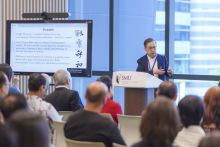
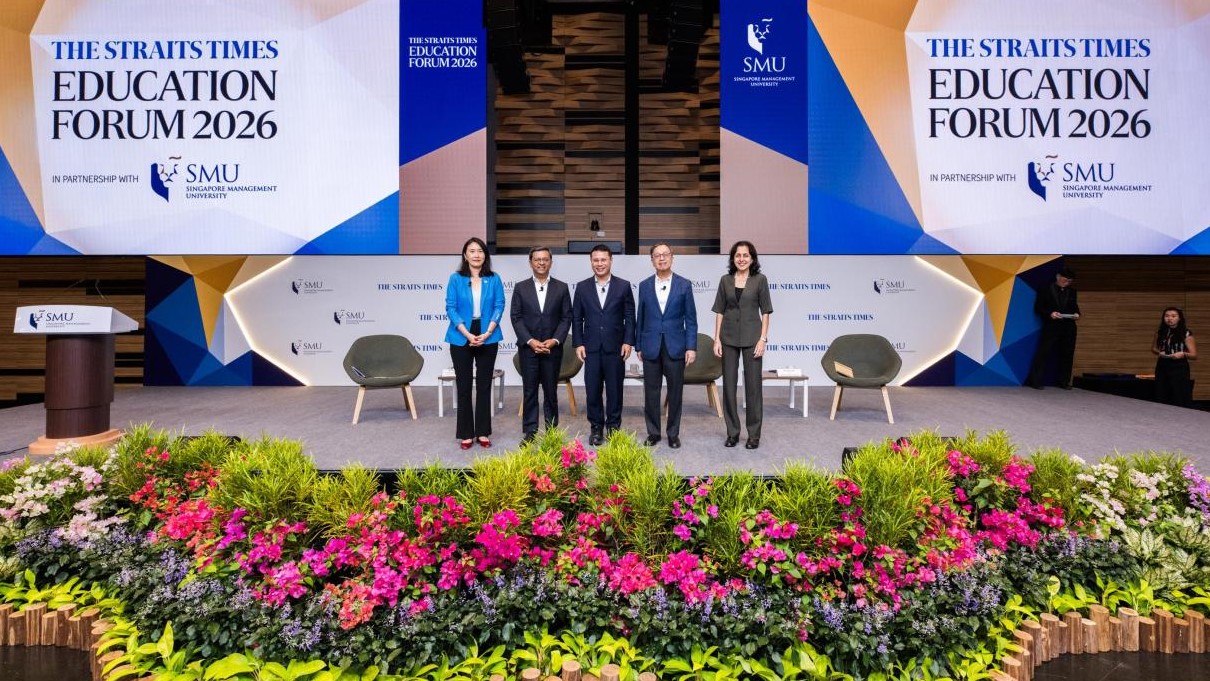
This was the focus of the 2026 Straits Times–SMU Education Forum, held on 1 April 2026 at SMU Hall. The forum brought together policymakers, industry leaders and academics to discuss how AI is shaping higher education, and what this means for teaching, assessment and graduate readiness.
“AI arrives with great promise, alongside deep uncertainty,” said SMU President Professor Lily Kong. “As economic resilience and workforce adaptability become global priorities, universities must ask not only how AI can transform teaching, but how it reshapes the way our students think, learn and reskill, and how they will work.”
Balancing opportunity and risk
AI does have potential in education, particularly in areas such as personalised learning and new teaching formats. At the same time, its limitations and risks remain under active discussion.
“Let’s be honest: it’s hard not to be excited about the potential benefits of AI in higher education – from its capabilities to personalise learning for students, to designing immersive learning environments,” said Ms Karamjit Kaur, Associate Editor, The Straits Times. “But as with everything else, there is a downside that we cannot ignore. The key question: Is AI helping or hindering learning?”
That balance between opportunity and risk framed much of the discussion.
Shifting the focus of education
In his keynote address at the forum, Minister for Education Desmond Lee highlighted the need to move beyond knowledge acquisition and towards deeper learning.
“Ultimately, what we want is to be able to… help our children and our young people to learn deeply… to be able to imbibe knowledge, adapt it, apply, and be critical about it,” he said.
Minister Lee added that education must develop judgment, empathy and cross-cultural competency, not just intellectual ability.
As AI becomes more capable at performing general tasks, the discussion pointed to a shift in emphasis, from producing answers to framing questions, and from broad knowledge to applied expertise.
Another recurring concern addressed during the forum was the risk of over-reliance on AI tools.
Minister Lee illustrated this using the legal profession, saying: “These tools allow lawyers to generate submissions for a case… but the senior lawyer, having gone through the rigmarole and the rigour of legal training and legal practice, will look at the submission and say, ‘Will this fly in front of the judge, and will it fly in front of this judge, given his or her temperament?’”
“If you say, ‘Well, if that can be done by an AI tool, then I don’t even need to go for the rigour of legal training’, I think that will be a big mistake.”
SMU Provost Professor Alan Chan also developed this point, arguing that universities must protect the fundamentals of learning even as AI becomes more capable.
“Without fundamentals, I fear many students will simply be driven by what comes out next, without really questioning the validity or value of such tools,” said Prof Chan, warning that convenience can come at the expense of intellectual discipline.
Drawing an analogy to gongfu, he noted that mastery in any field begins with strong basics, and that AI should not short-circuit the hard work of learning to reason, practise, and refine judgment over time.
Reinforcing human-centred skills
To address these concerns, SMU’s approach positions AI as a tool to support—not replace—education, with Prof Chan emphasising that the central task for universities is to keep learning “powerfully human” even in an age of generative and agentic AI.
“While AI is a powerful tool, over-reliance can hinder metacognitive development—the ability to understand and regulate one’s own thought processes,” said Prof Chan.
For that reason, he said SMU is doubling down on human-centred competencies such as critical thinking, ethical judgment and communication. Rather than treating AI as a standalone topic, students are encouraged to “critically interrogate” AI throughout their learning—testing outputs against evidence, surfacing assumptions, and articulating what they accept or reject and why.
The discussion also noted the continued relevance of disciplines that help students interpret and evaluate information, particularly in complex or uncertain contexts.
From individual use to broader impact
Against this backdrop, Raghav Gupta, Head of Education (Asia Pacific) at OpenAI, highlighted a gap between individual productivity gains and broader organisational or societal impact.
“But we’re all seeing personal productivity gains,” he said. “Only some of us are seeing gains at the productivity level in teams… and very few countries are seeing it at the societal level or a country level.”
“Technology is evolving very quickly, but there’s a lot to be done when it comes to diffusion of that technology, to really have productive impact.”
He added that universities play a role in helping students apply AI effectively.
“Skills like problem-solving are shifting to problem-framing, because AI can help you possibly solve that problem once you’ve framed it correctly.”
Building resilience
The forum also highlighted resilience as a key capability for graduates.
“You can have the best academic mind, but if you don’t have the steel of resilience… when the workplace changes, when the industry sunsets suddenly, and you can’t adapt, then I think that will not go well,” said Minister Lee.
To support this, the Ministry of Education plans to engage stakeholders in discussions on how to reduce excessive competition while maintaining motivation to learn.
“We want to… think about ways in which we can reduce the ‘arms race’ without diminishing motivation and drive to learn and to excel,” he said.
The discussion concluded with a shared view that AI will continue to shape higher education, but its impact will depend on how it is used.
“Our greatest fear is if AI hobbles us, clouds our judgment…and it becomes the master,” said Minister Lee. “The greatest hope is that it augments humanity and empowers us to be even more.”
For universities, the priority is clear: to integrate AI in ways that strengthen learning, while maintaining a strong focus on very human judgment, critical thinking and adaptability.
See also: