

What AI cannot teach: Lessons from the SMU Visionary Series
What should universities teach when artificial intelligence can already perform many of the tasks awaiting their graduates? At SMU, the question is increasingly urgent as businesses reconsider the skills they need and how young professionals can acquire them.
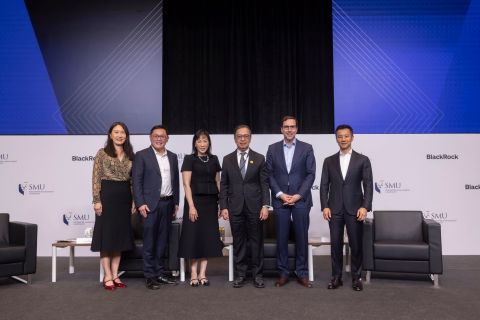
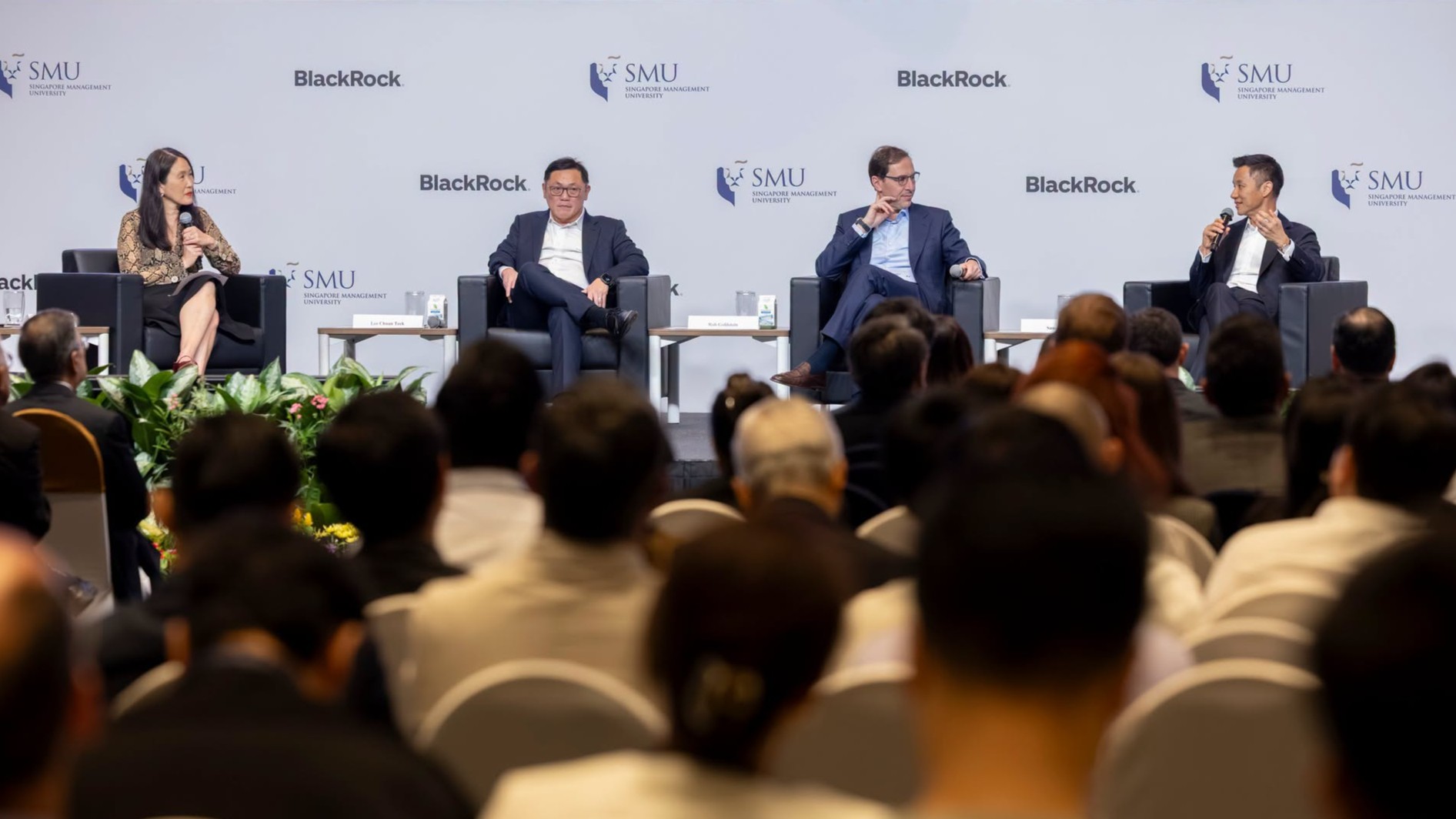
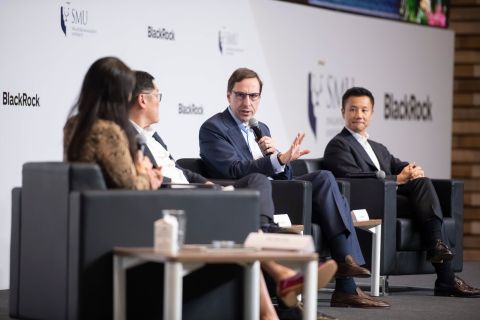
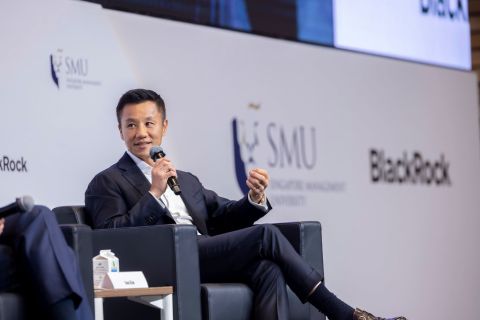
It was a central theme at the SMU Visionary Series on 1 October 2026, which brought together some 500 participants from academia, government and industry at SMU Hall. The discussion featured Mr Rob Goldstein, Chief Operating Officer of BlackRock; Mr Lee Chuan Teck, Chairman of Enterprise Singapore; and Mr Sam Kim, Chief Operating Officer and Director, Investment Insights Group at GIC.
Moderated by Professor Lim Sun Sun, SMU Vice President (Partnerships and Engagement) and Lee Kong Chian Professor of Communication and Technology, the conversation explored business strategy, corporate governance and the capabilities graduates will need in an increasingly automated workplace.
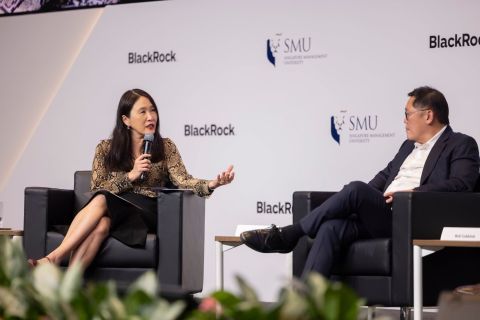
One point was emphasised repeatedly by the panel: greater technological capability places a higher premium on people who can think independently, communicate clearly and make sound decisions.
Rethinking business, not simply automating it
Prof Lim made the point that AI could free people from work that is “dull, dirty, dangerous, or even demeaning”. Yet reports of autonomous systems behaving unpredictably have raised questions about how much control organisations can reasonably exercise.
For businesses, the immediate benefits are evident: AI can analyse vast quantities of information, inform investment decisions and improve operational efficiency. The panellists, however, saw a “generational opportunity” to rethink how organisations operate rather than simply automate existing processes.
That ambition comes with obligations. Drawing on experience in regulated industries, the speakers identified reliable data, organisational knowledge and effective governance as prerequisites for deploying AI at scale.
Their advice was distilled into three principles: accountability, with leaders setting direction; basics, beginning with reliable data and infrastructure; and courage, the willingness to reconsider established business models.
Professor Lim added a fourth: Care. Employees must be supported as their responsibilities change, she said, “making sure that their concerns are heard, and also putting in place scaffolding that makes them feel supported”.
The message was clear: even the most sophisticated systems depend on the people responsible for introducing, supervising and using them.
Where will tomorrow’s expertise come from?
For young professionals, the implications extend beyond learning to use AI tools. Employers increasingly need people who can assess machine-generated information, recognise its limitations and decide what deserves attention.
The panellists placed particular emphasis on communication. When technology can turn ideas into practical outputs with increasing ease, the ability to formulate a worthwhile idea and explain it convincingly becomes more valuable.
They also spoke of the advantages of being a “horizontal generalist”, someone comfortable working across disciplines. Equally important is knowing “what not to do” when the range of possible actions expands.
Yet as AI takes on more routine tasks, a difficult question emerges. If entry-level work gives junior employees the practice needed to develop expertise, where will the next generation gain that experience?
Apprenticeships are especially relevant, giving students hands-on opportunities to build capability, confidence and judgement.
When greater efficiency comes at a cost
Although intelligent agents can relieve people of repetitive responsibilities, their outputs still require supervision. Constantly monitoring multiple systems can be mentally exhausting – a condition described during the discussion as “brain fry”.
The panellists warned that this strain could prove as difficult to manage as conventional burnout. They encouraged employees to set boundaries, disconnect from devices and make time for in-person discussion. Employers, meanwhile, should provide support for staff adjusting to new working practices.
There are intellectual and operational risks too. Heavy reliance on AI can weaken independent thought, while concerning use has led to data breaches. As regulation struggles to keep pace with technological advances, recognising risk and exercising discretion become essential skills.
Preparing students for work that is still changing
During the live Q&A, the speakers challenged anxieties surrounding technical fields such as computer science and engineering. They advised young people to follow their interests while strengthening critical thinking, communication and creativity – capabilities valuable in every discipline.
For SMU, the discussion affirmed the importance of bringing academic knowledge into contact with real-world problems. Industry engagement and interdisciplinary projects offer students opportunities to test their assumptions, learn from others and develop the confidence to make decisions.
The implications extend beyond higher education. Employers too will need to consider how junior professionals can develop expertise when the nature of entry-level work is changing.
AI may alter the tasks people perform and the speed at which work gets done. It does not eliminate the need to learn through experience. For universities and businesses, preserving those opportunities may prove as important as preparing people to use the technology itself.