What is different because of what we do? It is a question that goes to the heart of how SMU defines its success, and one that President Professor Lily Kong placed before the University community at the President’s State of the University Address (PSOUA) 2026.
In a personal letter that opened the Address, Prof Kong encouraged the University to look beyond conventional measures of academic achievement: from publications and citation counts to rankings. The more consequential measure, she suggested, is what changes because of SMU's presence – the opportunities created for students, the knowledge that informs decisions in industry and governments, and the improvements made to communities and society.
A LETTER TO SMU
Why do we do the work we do at SMU? Ultimately, it is to make a difference.
To change what is possible for a student.
To bring new knowledge into the world.
To help solve problems that matter.
To strengthen the communities and society we are a part of.
That is impact.
It is not simply about what we achieve. Publications. Citation counts. Rankings.
It is about what changes because we are here.
What is different because of what we do?
SMU’s ambition should never simply be to do more.
It should be to matter more – to our students, our partners, our communities, and to society.
That is what impact means. And that is the opportunity before us.
Lily Kong
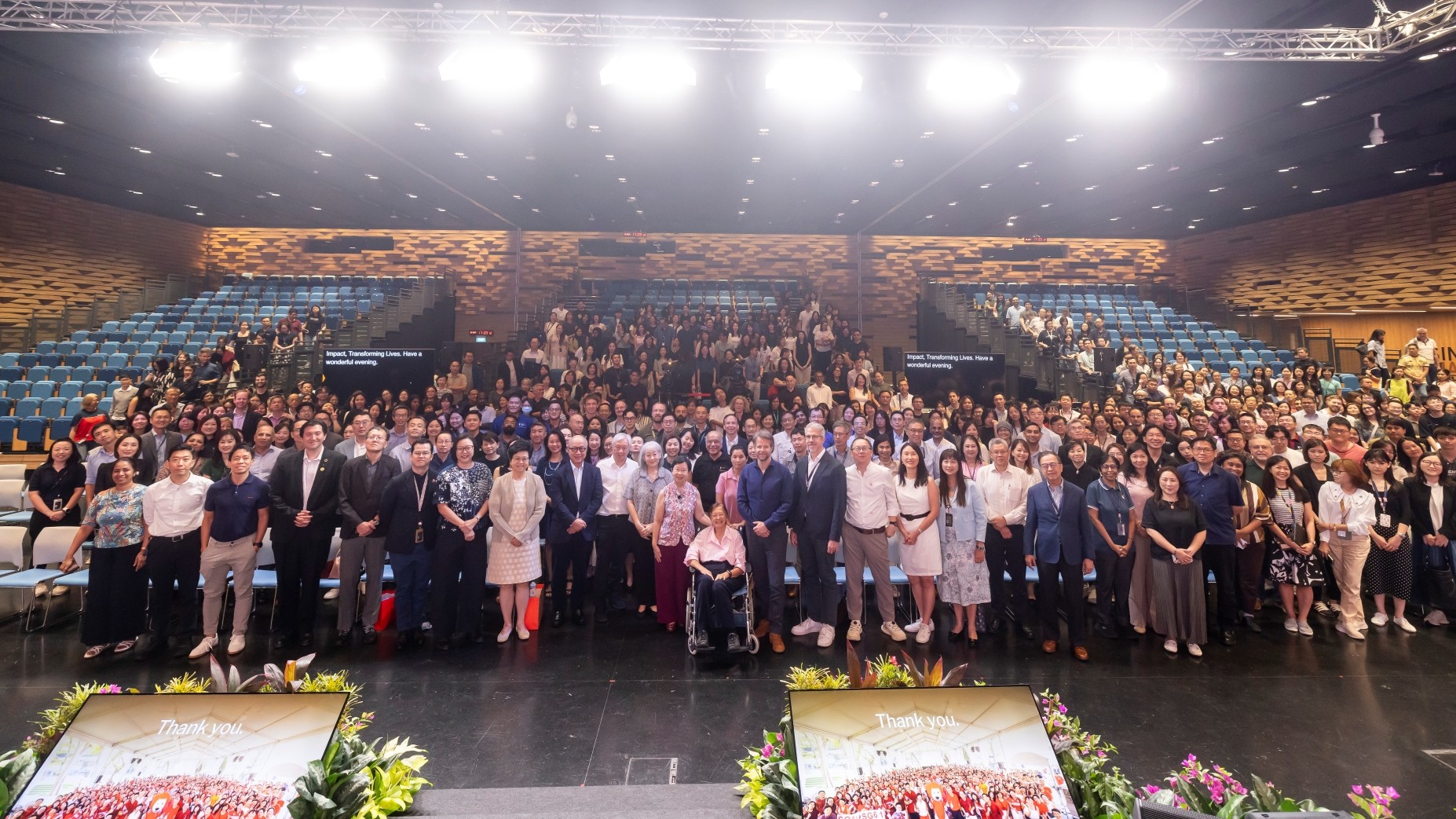
PSOUA was held at SMU Hall on 25 September and attended by about 540 faculty and staff. The Address marked a significant point in the University's SMU2030 journey. Building on last year's theme, “Shaping Impact, Transforming Lives”, PSOUA 2026 continued those ideas with the theme “From Commitment to Momentum”, and set out how SMU intends to translate its strategic priorities into sustained results.

Making impact measurable
For universities, success has traditionally been assessed through measures such as research output, academic reputation and graduate achievements. These remain important, but they do not necessarily capture the full extent of an institution's contribution to society.
Prof Kong called for a broader understanding of SMU's impact across four interconnected domains: human capital development, knowledge creation, economic development, and social and community life.
Central to this approach is the Input-Output-Outcome-Impact (IOOI) framework, introduced at PSOUA 2025. It encourages the University to examine the progression from resources invested and activities undertaken, to the outcomes achieved and the lasting changes that follow.
“Activity is not the same as impact, and aspiration is not evidence,” Prof Kong said.
The distinction raises an important question for any university seeking to demonstrate its value: how can it establish that its teaching, research and partnerships have made a difference beyond their immediate results? For SMU, answering that question will require stronger evidence, closer collaboration and a willingness to examine what happens after an initiative concludes.

The Office of Impact will work with SMU’s Schools, Colleges, Institutes and administrative units to document evidence, develop case studies and share good practices. The aim is to make SMU's contributions more visible while strengthening how impact informs future decisions.
“The University is rightly focused on measuring and communicating the impact of its work across research, education and service,” commented Professor Shantanu Bhattacharya, Professor of Operations Management and Deputy Dean (Education) at the Lee Kong Chian School of Business, after the Address
“SMU moved from a set of values for SMU2030 – commitment – to a set of tangible actions – momentum – that stakeholders across the University can understand and contribute to.”
Preparing for a lifetime of change
The shift from ambition to action will be particularly evident in education, where technological advances and changing workforce demands are challenging conventional assumptions about how long a university education should serve its graduates.
SMU's AI-in-Education Strategy, Enhanced Core Curriculum and next evolution of SMU-X will support a more adaptable and applied approach to learning. Students can expect more personalised guidance, expanded opportunities across Asia and greater exposure to interdisciplinary, real-world challenges.

Beyond undergraduate education, SMU will strengthen its postgraduate, executive and professional education offerings through new programmes and stackable lifelong-learning pathways.
For Yuehan Zhuo, Associate Director at the College of Integrative Studies, Prof Kong's question, “What if learning is not for a single career, but for a lifetime of learning?”, captured a fundamental shift in educational priorities.
“Equipping students with skills for a job is important, but preparing them to unlearn, learn, relearn and synthesise for life is essential,” he said.
The same emphasis on practical outcomes will guide SMU's research agenda. Its three university-level research institutes, the Longevity Societies and Economies Institute, Resilient Workforces Institute and Urban Institute, will deepen work on challenges affecting societies and economies.
These efforts will be complemented by research spanning sustainability, urbanisation, workforce transformation, cybersecurity, trade, finance and dispute resolution, with greater attention to how findings inform policy, professional practice and public understanding.
Partnerships will help extend that reach. SMU plans to deepen engagement with universities, industry, government and community organisations, while expanding its presence in Asia through initiatives including a new SMU China overseas centre in Shenzhen.

A collective responsibility
While PSOUA 2026 set out institutional priorities, it also underscored the role of individual contributions in determining whether those priorities succeed.
For Yvonne Chan, Chief Financial Officer and Vice President, the Address clarified how different parts of the University contribute to a common purpose.
“This year’s PSOUA brought SMU2030 to life by showing how every department has a part to play in achieving our shared vision,” she said. “It left me optimistic about how we can work together to extend SMU’s impact beyond our shores.”
That sense of shared purpose found an unexpected expression in music. Faculty and staff contributed songs to the SMU Shaping Impact Spotify Playlist, with selections including Unstoppable, Roar, The Climb and Seasons of Love.
The Address concluded with Prof Kong's contribution to the playlist, For Good from the musical “Wicked”, , performed by Jimmy Ye, Director of the Office of Student Life, alongside Lennel Chua and Joy Foo from SMU VOIX.
For Weetz Seah, Head of Arts and Creative Experience at the Office of Student Life, the Address also offered an opportunity to reconsider the significance of everyday work.
“The question posed at the very start, ‘What is different because we are here?’, was simple yet powerful,” he said. “It prompted me to reflect on the difference our work creates and why it matters.”
That reflection points to the challenge ahead. Strategies can establish direction, and frameworks can help measure progress, but lasting impact depends on what happens over time. For SMU, the next phase will be judged by how effectively its commitments translate into opportunities, knowledge and improvements that endure.
Prof Kong closed with a reminder of what those collective efforts can achieve.
“Education can transform lives. Research can shape society. Partnerships can create opportunities that none of us could achieve alone,” she said. “Together, let us continue turning commitment into momentum, and momentum into lasting impact.”
The question that opened the Address therefore remains relevant long after the event itself: what will be different because SMU is here?