


Artificial intelligence is reshaping legal practice, and Singapore Management University’s (SMU) Yong Pung How School of Law (YPHSL) is preparing its students to navigate that change with confidence and sound judgement.
On 9 September 2026, YPHSL became the first university in Asia to join Legora’s Legal AI Scholars Program. The partnership gives faculty access, training and support to Legora’s agentic AI platform, widely used in legal practice for tasks such as legal research, large-scale document review and drafting. It also places SMU alongside US law schools in the programme, including Northwestern Pritzker School of Law, the University of Chicago Law School, Cornell Law School, the University of Texas School of Law, Boston University School of Law and the University of San Francisco School of Law.
The collaboration builds on the School’s track record at the intersection of law and technology. In 2023, it introduced a law and technology track, giving students cross-disciplinary exposure to the legal and regulatory questions raised by emerging technologies. A year later, it launched the Centre for Digital Law, which brings together expertise in law, computer science and the digital humanities.
The School has also strengthened the infrastructure needed to understand technology’s impact on the legal system. In 2025, it announced a three-year project, supported by Singapore’s Ministry of Law, to develop the country’s first open empirical legal database. In June 2026, it hosted the International Conference on Artificial Intelligence & Law, marking the first time the conference was held in Asia.
Together, these initiatives address a pressing question for legal education: what does it mean to be ready for practice when the tools lawyers use are changing as quickly as the laws governing them?
From understanding AI to using it
The Legora partnership brings that question directly into the classroom. Through the Legal AI Scholars Program, SMU faculty will first receive licences to the platform, and training from Legora’s Asia-Pacific legal engineering team and SMU Libraries. Access will then expand to students and courses as the School determines where the technology can best support learning.
This approach combines practical familiarity with the development of core legal capabilities. Students will encounter tools already used in legal practice while continuing to build the foundational skills and judgement expected of the profession.
Keeping human skills in view
For Professor Lee Pey Woan, Dean of YPHSL, adopting new technology also means being deliberate about the qualities technology cannot replace.
“Technology literacy is already embedded across SMU’s programmes; this partnership deepens the integration of AI competencies specifically within legal education,” said Professor Lee.
“Our students will practise law in a profession where AI is not optional but foundational. At the same time, we have introduced safeguards to preserve the rigorous development of foundational legal skills and cultivate the sound and ethical judgement that will remain a distinctive human value-add to the profession,” she added.
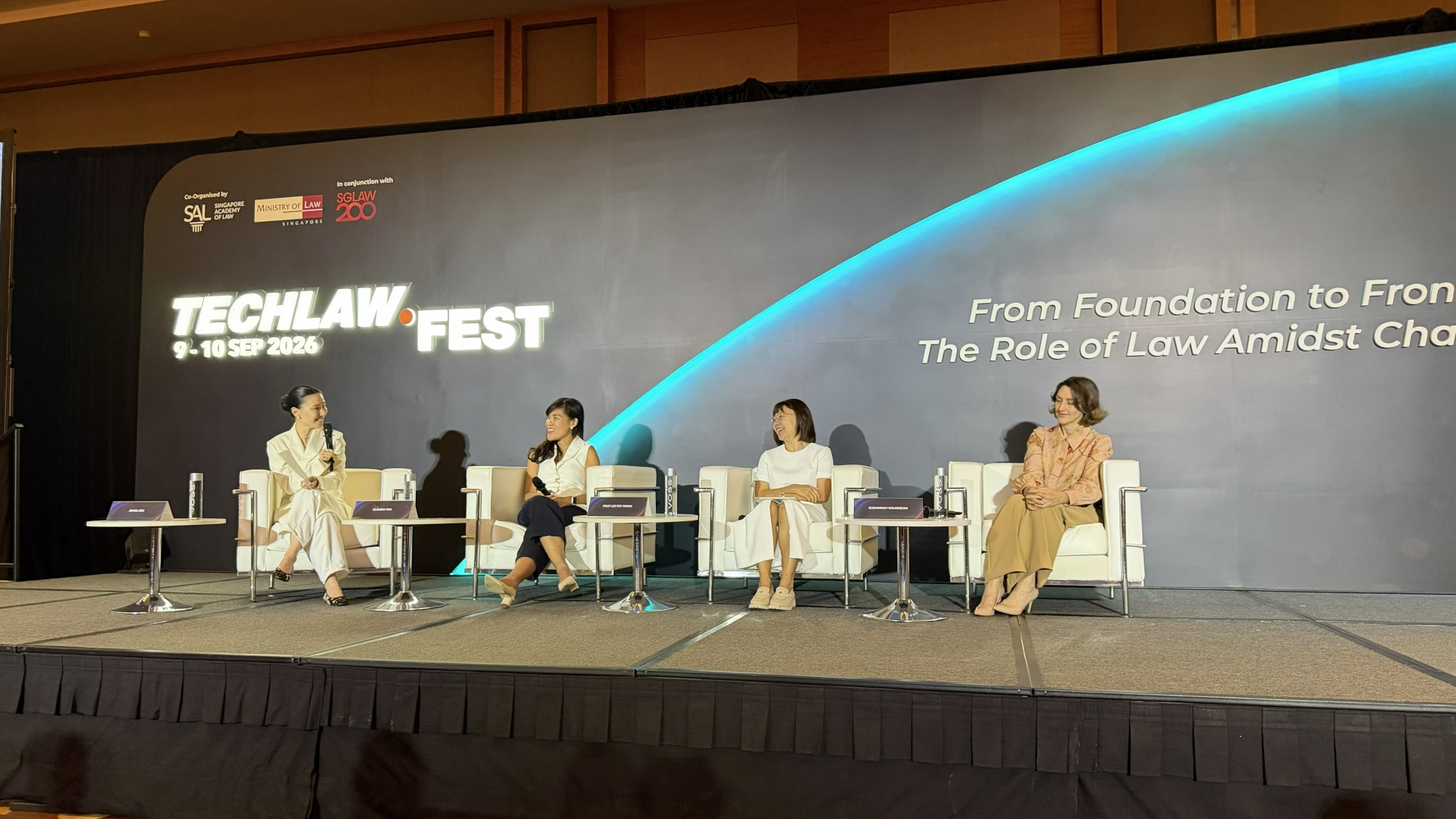
Prof Lee also spoke on a TechLaw.Fest 2026 panel on supervising AI agents, where panellists discussed how that shift is already playing out in practice. As agents take the first pass on routine work such as document review, drafting and comparison, they observed, the lawyer's value moves from producing the draft to directing and verifying it. Accountability does not move: competence, judgement and supervision remain non-delegable, even as the way those duties are discharged changes. Panellists also noted that junior lawyers may step into supervisory roles far earlier in their careers.
For Prof Lee, this makes supervising AI an explicit learning outcome. At a foundational level, universities should teach students to critique AI output by spotting gaps, inaccuracies and weak analysis, building healthy scepticism along the way. At advanced levels, assessments would move towards complex, problem-focused scenarios requiring layers of analysis that AI alone cannot carry.
Done well, she argued, AI can sharpen students' thinking rather than replace it, and even return legal education to its core purpose of forming judgement.
Legora’s team will work with SMU faculty to develop AI exercises and assignments for existing courses, supported by purpose-built guides, training videos and use-case-specific sessions. The aim is to make AI proficiency part of legal education rather than something graduates encounter only after entering practice.
Beyond the Classroom
SMU’s engagement with legal technology also extends beyond formal curriculum. Professor Lee was one of several SMU faculty members who shared their perspectives at TechLaw.Fest 2026.
Professor Lim Sun Sun, SMU's Vice President (Partnerships & Engagement) joined a panel on online safety that examined how trust in the digital ecosystem is being tested. Associate Professor of Law Jason Grant Allen, who is also Director of the university’s Centre for Digital Law, moderated a panel on AI Governance under the Rule of Law.
Furthermore, Associate Professors Warren Chick and Saw Cheng Lim launched Information and Communications Technology Law in Singapore (2nd Edition), while Assistant Professor Lim How Khang served as judges at the SMU LegalTech Hackathon.
Together with the School’s teaching and research, these activities reflect a wider institutional interest in how technology is changing legal work, regulation and education. The tools will keep changing; by examining AI as a practical tool, a subject of regulation and a test of professional judgement, the School aims to prepare students to understand it, question its use and apply it responsibly.