


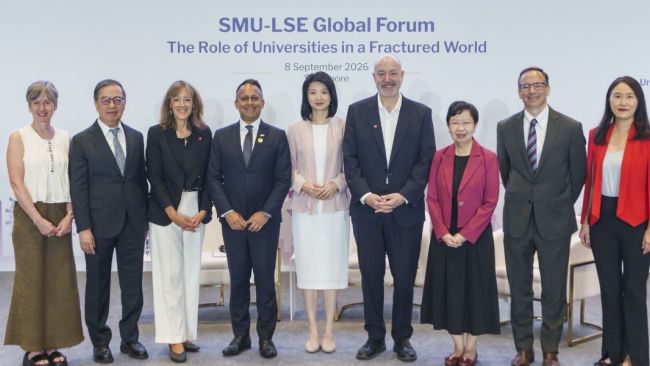
Putting purpose and people at the centre of a changing academic world
Published onSMU and LSE explore how universities can turn rigorous research into public value, addressing urban sustainability, artificial intelligence, leadership and healthy ageing together.

On 10 February 2023, SMU paid tribute to its longest-serving Trustee and Chairman, Mr Ho Kwon Ping who had stepped down from the position. Over two and a half decades, Mr Ho had made an incredible impact on the University and its growth, so it was only fitting that his contributions were recognised by both current and past members of the SMU Board of Trustees and an illustrious guest list of VIPs during the Appreciation Event for Mr Ho held at the SMU Hall.

SMU’s new Chairman, Mr Piyush Gupta, hosted Singapore President Madam Halimah Yacob at the University’s Patron’s Day celebration on 13 January 2023. After two years of holding the event in hybrid format, students, faculty, staff, friends of SMU and the members of the local community enjoyed the much-anticipated annual event live on campus. This year marks the 23rd anniversary of Singapore Management University (SMU) and to commemorate the occasion, SMU students, alumni, staff, and members of the public gathered at Campus Green for an extravaganza event like no other.

During SMU’s first Presidential Distinguished Lecturer Series (PDLS) held overseas, in Jakarta, SMU President Professor Lily Kong moderated an eminent panel who spoke on the importance of developing a talent pipeline pertaining to sustainability in Indonesia, as well as exploring various strategies to help bridge existing skills shortages.
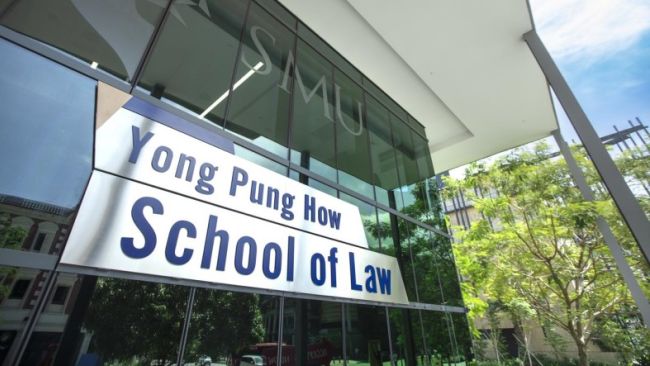
A generous $20 million gift from the family of the late Dr Yong Pung How sets to establish a financial aid programme, fellowship programme and a research fund to further the legal discipline at SMU’s Yong Pung How School of Law.

The first SMU Overseas Centre is proud to nurture a knowledge climate in which intellectual and cultural diversity is respected and embraced, to drive the economic development of communities and sectors in Indonesia. In an age of rapid technological advancement and globalisation, the need for knowledge exchange between different regional networks has become increasingly important. To drive its strategic priority of Growth in Asia, SMU has unveiled its first Overseas Centre in Jakarta, Indonesia.
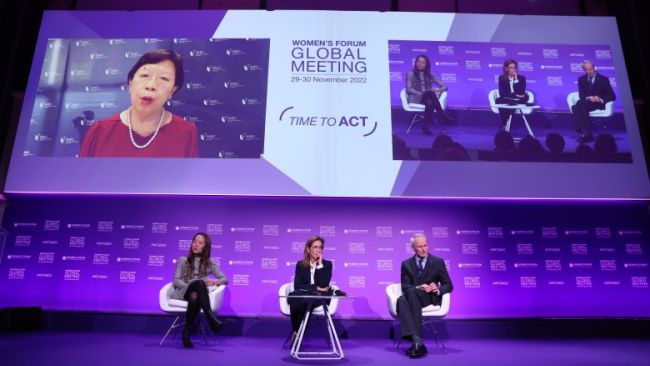
Education is a fundamental right that should be accessible to everyone, no matter their circumstances. In order to navigate a world that is in flux, it is important to foster skills beyond traditional domain knowledge. SMU President Professor Lily Kong spoke about the education and skills we most need in an age of transformation during the panel discussion, Skills and Education in the Race for Humanity, at the 2022 Women’s Forum Global Meeting.
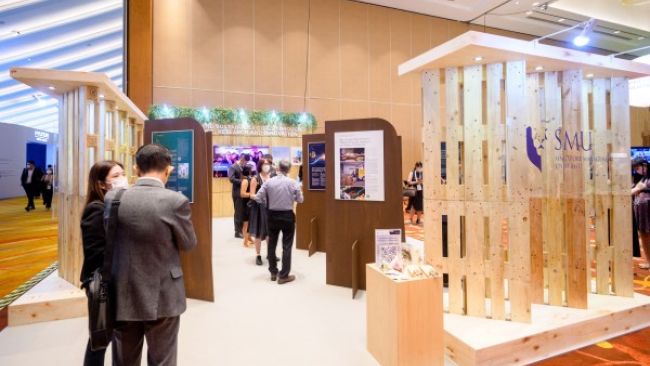
There's no escaping it: we all have a role to play in sustainability. Individuals, businesses and governments all need to do their part if we're going to avert the most catastrophic effects of climate change. But what about universities? What role can they play in building sustainability? Turns out, institutions of higher education can make a big difference.
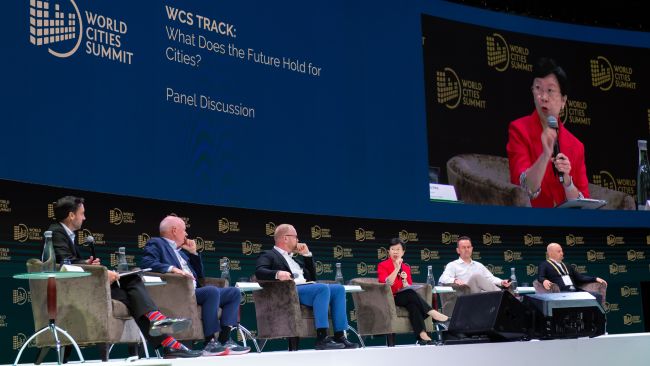
In a post-pandemic world, rocked by geopolitical crises, the future of cities has never been more uncertain. Whatever they should look like in the future, leaders should always place humans and their needs at the forefront of city development, said Professor Lily Kong, SMU President and Lee Kong Chian Chair Professor of Social Sciences.
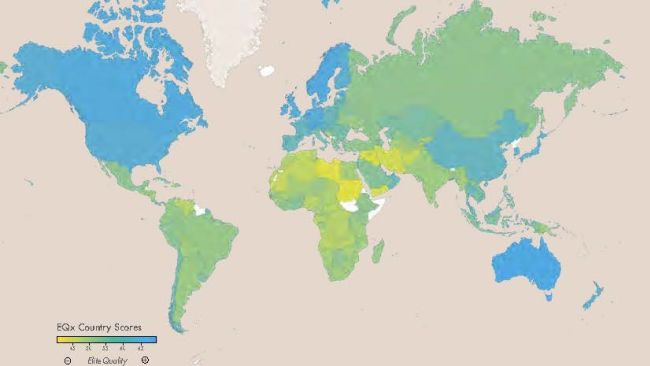
“Elites” is often a term imbued with negative connotations.
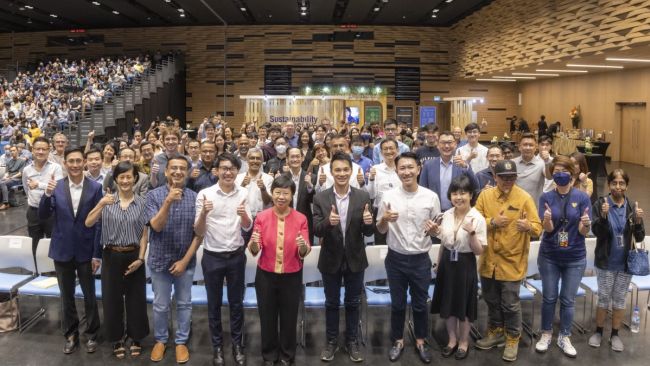
President’s State of the University Address 2022 Singapore has long been known as a garden city, and with good reason. The city is home to an abundance of greenery, from the carefully manicured gardens of the Botanic Gardens to the lush foliage of Pulau Ubin.