


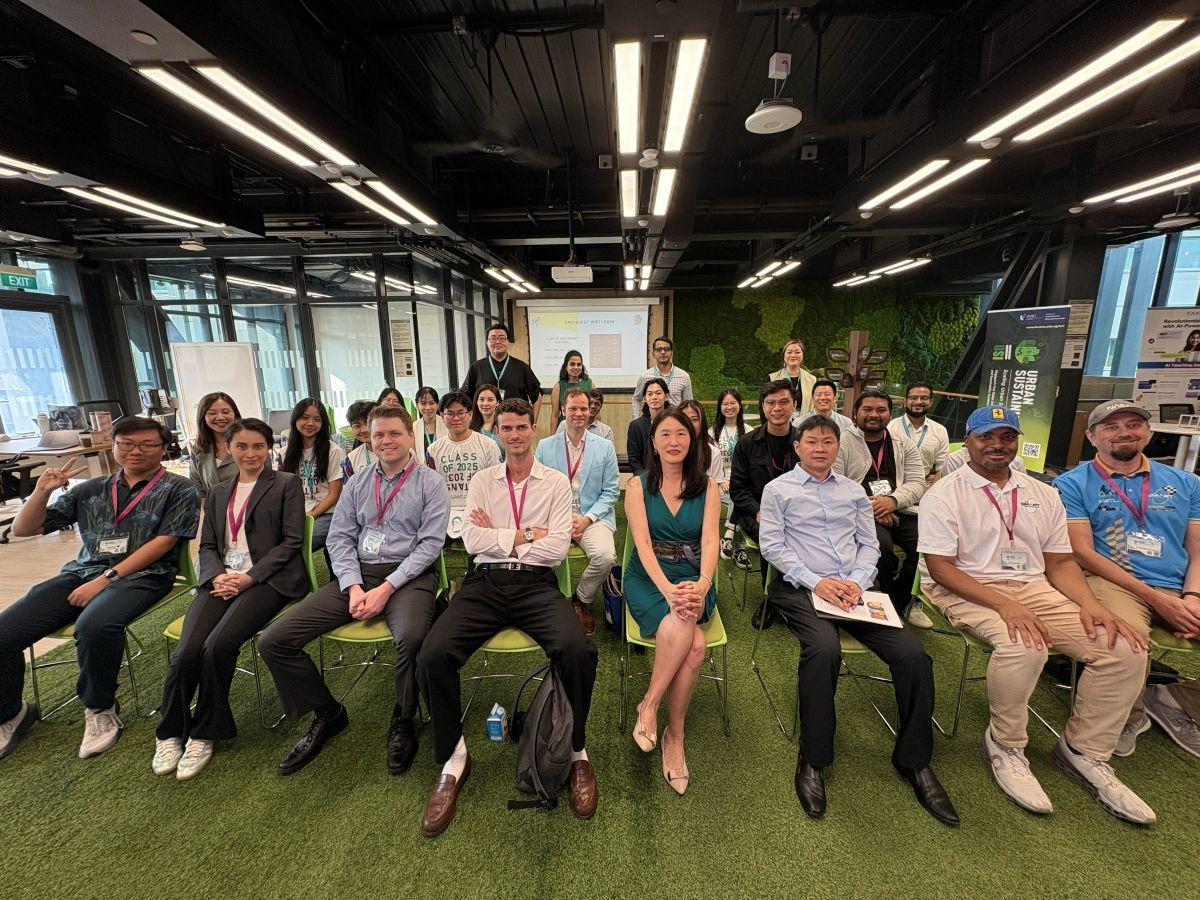
SMU has formally welcomed the first seven startups selected for the Urban SustaInnovator (USI), the University’s flagship deep tech accelerator programme. The announcement marks a significant step in SMU’s continued expansion of its global innovation ecosystem and reinforces its role in advancing urban and sustainability solutions.
USI is Singapore’s first global accelerator dedicated specifically to scaling and anchoring breakthrough solutions in the urban and sustainability space.
The 12-month hybrid, non-residential programme is designed to support high-potential ventures while positioning Singapore as a gateway to Asia for deep tech enterprises.
The inaugural cohort was selected from 1,500 applicants across 91 countries, reflecting both the programme’s international reach and the competitiveness of its selection process.
From global competition to structured acceleration
USI was launched last September at the 12th edition of SMU’s Lee Kuan Yew Global Business Plan Competition (LKYGBPC) by Mr Chee Hong Tat, Singapore’s Minister for National Development. The accelerator builds on the competition’s long-standing platform for identifying and supporting high-potential founders.
Hosted by SMU’s Institute of Innovation and Entrepreneurship (IIE), the programme draws from past LKYGBPC finalists. The selected startups are developing advanced technologies including self-healing concrete, nanotechnology-enabled photosynthesis to improve farming yields, plastics produced in a fully circular process that eliminates carbon emissions, and airless wheels derived from space technology.
These ventures represent applied research translated into commercially viable solutions, which is the type of innovation the University aims to support.
Anchor in Singapore, scale for the world
Welcoming founders and mentors to the first of four quarterly deep-dive sessions, Professor Lim Sun Sun, SMU’s Vice President of Partnerships and Engagement and Chair of the USI Programme Management Committee, highlighted the University’s commitment to purposeful innovation.
“The Urban SustaInnovator reinforces SMU’s commitment to driving innovations that transform lives. Together, we’ll look to foster global talent, elevate knowledge in Singapore’s workforce, and catalyse ground-breaking solutions that address today’s pressing climate problems.”
Her remarks coincide with broader national investment in the sector. “With S$40 million of investments recently announced by the Ministry of National Development (MND) and Ministry of Sustainability and the Environment (MSE) in developing, piloting and commercialising promising urban and sustainability solutions, Singapore is becoming a dynamic global Deep Tech gateway to Asia,” she added.
A clear framework for growth
Each startup begins the programme by setting defined 12-month milestones. Every team is paired with a Lead Mentor drawn from USI’s consortium of business, scientific and government leaders, ensuring sustained and specialised guidance.
Beyond individual mentorship, USI provides structured access to venture capitalists, research institutions, corporates and regulators. Support includes preparation for fundraising, facilitation of pilot deployments, regulatory guidance and pathways to commercialisation.
The programme operates on a zero-equity, zero-fee basis. It is backed by a public–private consortium comprising Agency for Science, Technology and Research (A*STAR), Antler, Building and Construction Authority, Energy Market Authority, ST Engineering, The GEAR by Kajima, TRIREC, and Wavemaker Partners.
This cross-sector collaboration reflects the complexity of bringing deep tech solutions to market, particularly in regulated and infrastructure-intensive industries.
Professor Lim noted that USI complements initiatives such as the National Graduate Research Innovation Programme (National GRIP), contributing to a coordinated ecosystem that connects deep tech founders with sustainability, technology and business partners across universities worldwide.
Regional access and talent development
Through SMU’s regional presence in Indonesia, Thailand and Vietnam, participating startups can explore partnerships and pilot opportunities across Southeast Asia. This regional access supports the programme’s objective of helping ventures establish an operational base in Singapore while expanding into Asia.
Startups may also draw on SMU’s talent initiatives, including the Global Innovation Immersion programme, to support early-stage hiring and capability building during expansion.
Building on a strong foundation
USI builds on more than two decades of SMU’s experience in entrepreneurship development. Since its inception in 2002, LKYGBPC has evolved from a business plan competition into a sustained platform for mentorship, global exposure and venture development.
SMU’s incubator, the Business Innovations Generator, has also delivered strong results. Nearly 40 per cent of its startups focus on advancing the United Nations Sustainable Development Goals. Over the past five years, these ventures have collectively raised more than S$875 million.
The launch of USI’s inaugural cohort underscores SMU’s long-term commitment to supporting innovation that addresses urban and environmental challenges. By combining academic expertise, industry partnerships and regional connectivity, the University continues to strengthen its position as a convenor of high-potential ventures.
As the first cohort progresses through its 12-month programme, the focus will remain clear: to support credible, scalable solutions and to reinforce Singapore’s standing as a base for deep tech enterprises serving Asia and beyond.