

SMU team triumphs at Gobi Desert Challenge with sole ESG Team Award
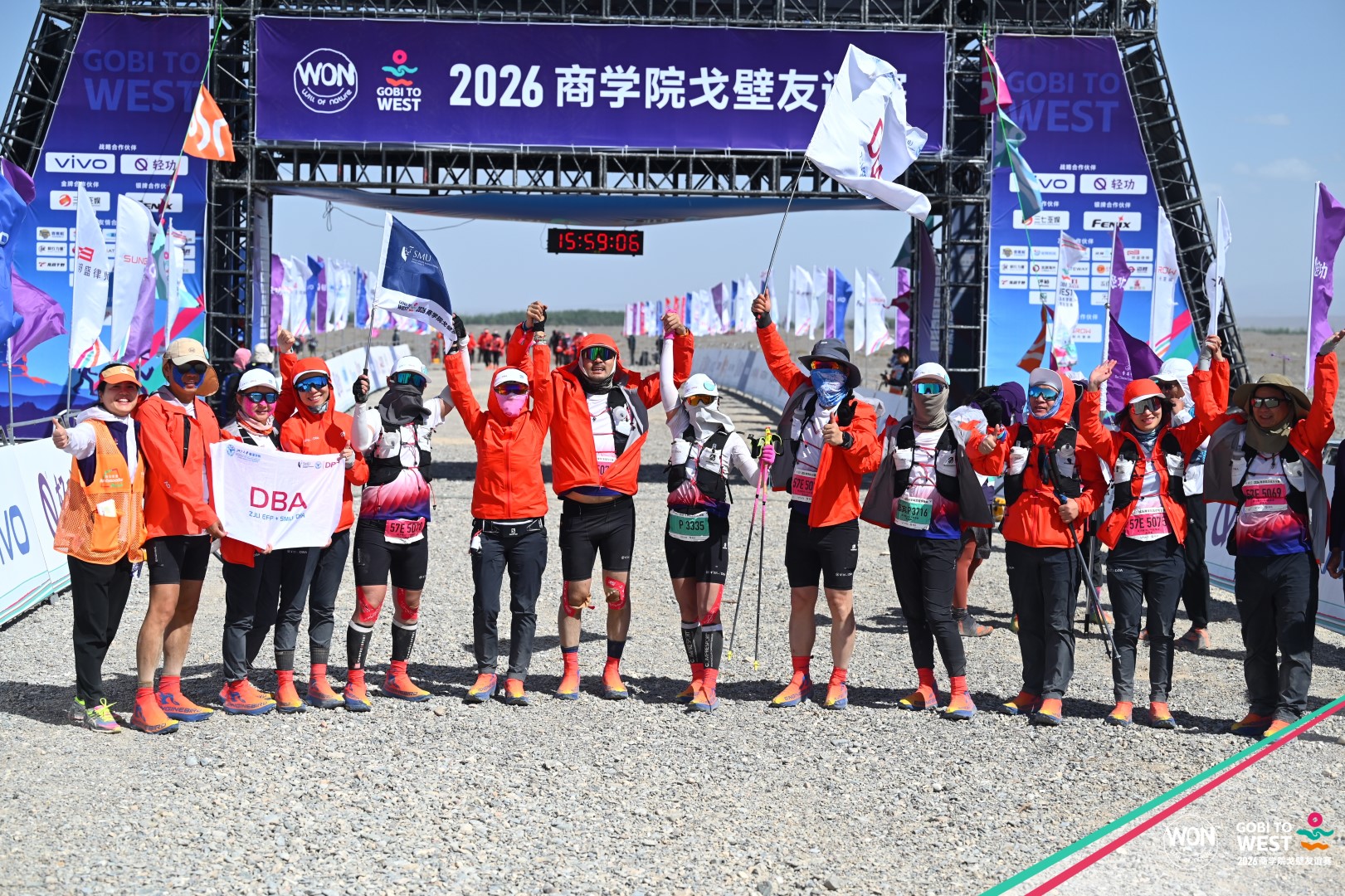
The Singapore Management University-Zhejiang University Doctor of Business Administration (SMU-ZJU DBA) (Accounting and Finance) team has become SMU’s first team to complete the renowned Gobi Desert Challenge, (or “Gobi to West”), and emerged as the sole recipient of the event’s Model Environmental, Social and Governance (ESG) Team Award among more than 100 participating teams from leading business schools and executive cohorts across the region.
Led by SMU’s School of Accountancy, the 14-member team completed a demanding 58km trek across the Gobi Desert while demonstrating environmental stewardship, teamwork and sustainability leadership under challenging conditions.
A test of leadership beyond the classroom
Widely regarded as one of the most prestigious endurance events in the global business school community, the Gobi Desert Challenge brings together senior executives, entrepreneurs, MBA, EMBA and doctoral participants to navigate rugged terrain while testing their resilience, leadership and ability to work collectively under pressure.
This year’s challenge centred on ESG and the concept of “business for good”, providing participants with an opportunity to put these principles into practice rather than merely discuss them in a classroom setting.
The SMU delegation was led by Professor Zhang Liandong, Dean of the SMU School of Accountancy, as well as by School of Accountancy DBA Programmes Lead, Ms Liu Fei. The team comprised entrepreneur-doctoral participants and alumni from the SMU-ZJU DBA programme, many of whom balance leadership responsibilities in their organisations with rigorous doctoral research.
Over four days, participants traversed desert terrain in temperatures reaching 30°C while coordinating closely with teams from more than 40 institutions.
Sustainability in action
The Model ESG Team Award recognised the SMU team’s systematic application of ESG principles throughout the challenge.
Organisers highlighted the team’s “leave-no-trace” approach to minimising environmental impact, its efforts to foster inter-school exchanges and collaboration, and its contribution to advancing ESG awareness among participants. The team was also recognised for helping to shape the event’s evolving sustainability framework.
Notably, organisers cited SMU’s ability to connect academic research with practical implementation, recognising the team’s professional contributions to the continued development of the challenge’s ESG agenda.
The achievement reflected a key objective of the SMU-ZJU DBA programme: bringing together scholarly inquiry and practical leadership to address real-world challenges.
Recognition rising from desert environs
For Professor Zhang, the award represented more than success in an endurance event. It demonstrated how values and leadership can be tested under demanding circumstances.
He said: “To emerge as the sole winner in this category among more than 100 teams is a significant achievement and a strong affirmation of SMU’s commitment to translating sustainability principles into action.”
Participants described the challenge as one that required mental discipline as much as physical stamina.
Team participant Wang Yi (SMU-ZJU DBA, class of 2025), Huatai United Securities, Managing Director, said: “The Gobi challenged us to practise environmental, social and governance principles in one of the toughest possible settings. After 58km, the biggest challenge was not physical endurance but mental resilience: steeling your resolve and continuing across the harsh desert terrain.
“Just like running a business or leading a team, one must make responsible decisions, support one another, and stay true to shared values under pressure,”
Extending the conversation on responsible leadership
The team’s contribution extended beyond the desert trek.
As part of the event’s intellectual programme, Professor Zhang and SMU-ZJU DBA alumni participated in a talk-and-panel-discussion on artificial intelligence, exchanging perspectives with senior executives, entrepreneurs and doctoral participants from business schools across Asia.
The discussions reinforced the programme’s broader emphasis on equipping leaders to navigate emerging business challenges while balancing innovation, governance and social responsibility.
As SMU’s first team to complete the Gobi Desert Challenge, the accomplishment represents an important milestone for the University.
More significantly, it highlights the growing presence of SMU within the regional executive education community and demonstrates how the University’s academic programmes encourage leaders to apply research, critical thinking and responsible decision-making beyond traditional learning environments.
In a challenge designed to test both endurance and judgement, the recognition serves as a reminder that leadership is measured not only by results achieved, but also by the values upheld along the way.