

SMU President conferred 2026 CASE Asia-Pacific Leadership Award
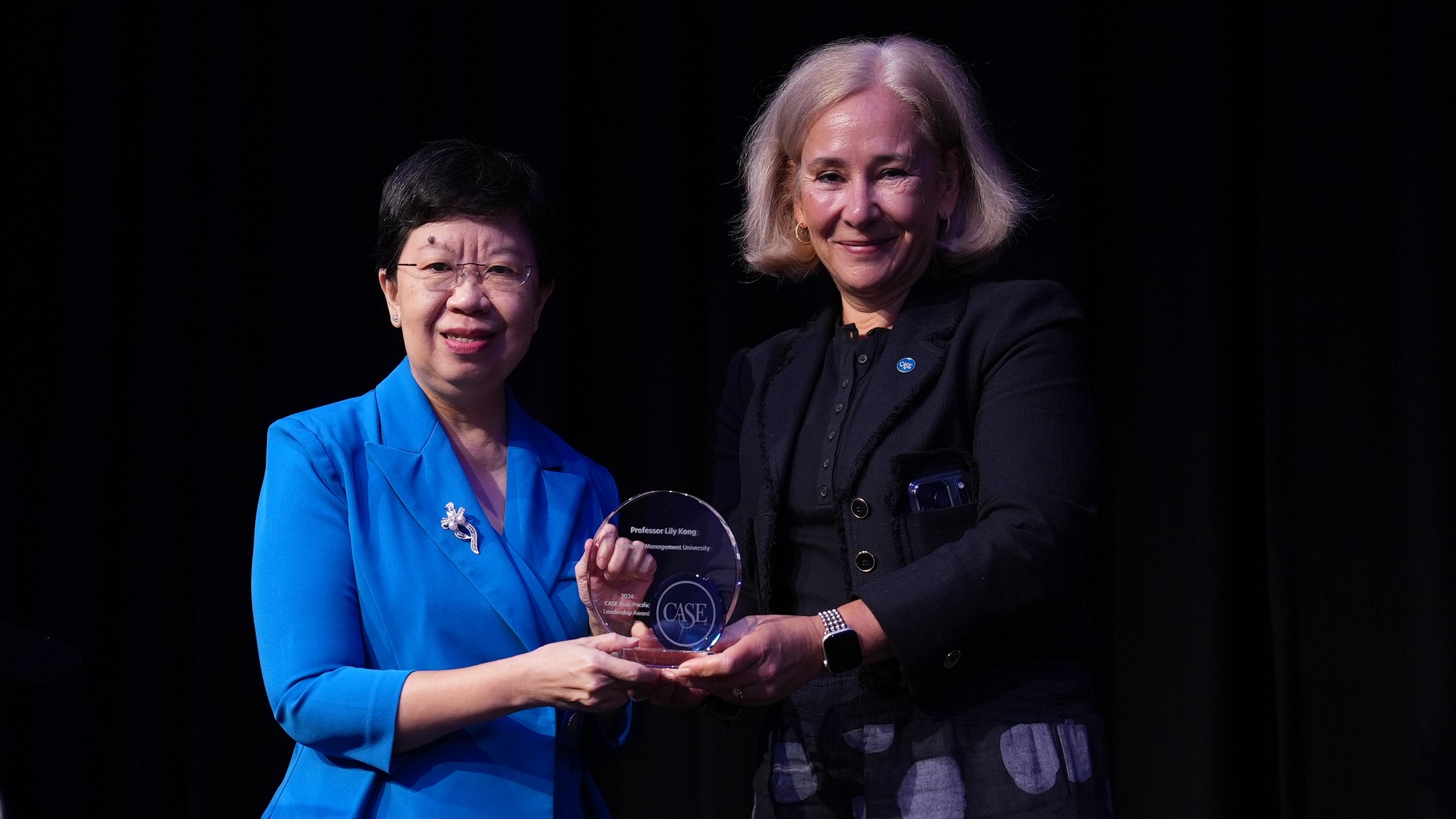
SMU President Professor Lily Kong was conferred the 2026 CASE Asia-Pacific Leadership Award at the CASE Asia-Pacific Advancement Conference in Brisbane from 5-8 May.
Conferred by Council for Advancement and Support of Education (CASE), the award recognises institutional leaders for outstanding efforts in advancing education and strengthening institutional engagement across alumni relations, communications, and philanthropy. CASE is the Council for Advancement and Support of Education, a global non-profit association founded in Washington, DC, in 1974 that today serves nearly 3,700 educational institutions across more than 80 countries.
In announcing the award, CASE President and Chief Executive Officer Sue Cunningham said that under Prof Kong’s leadership, SMU had “reached new heights of academic excellence, global relevance, and societal impact”, adding that her “inspirational leadership has grown SMU into a leading Asian university and world-class institution”.
Spearheading SMU’s growth
Prof Kong became the first Singaporean, and the first woman, to serve as SMU President when she took office in 2019. Under her tenure, SMU broadened its international presence, increased investment in interdisciplinary research, and introduced new initiatives centred on sustainability, workforce resilience, and demographic change.
Among the developments launched during this period are the SMU Longevity Societies and Economies Institute, the SMU Resilient Workforces Institute, the SMU Urban Institute, and the Singapore Green Finance Centre. SMU also established Offices of Overseas Centres overseeing activities in Indonesia, Thailand, and Vietnam, reflecting the University’s increasing emphasis on regional engagement.
This year, SMU was named the world’s most improved university among institutions with 10 or more ranked subjects in the international QS Subject Rankings, a result that reinforces the University’s growing international profile, and is complemented by three further milestones: a best-ever top 8% position in Asia (#122), continued upward movement in global rankings, and multiple subjects now placed within the global top 50.
Those achievements have unfolded alongside a broader institutional shift. Under Prof Kong’s leadership, SMU became the first university in Singapore to require sustainability education for all undergraduates. Its campus has since attained BCA Green Mark Platinum certification, including one Net Zero building and one Super Low Energy building.
Yet colleagues and alumni often point not first to infrastructure or rankings, but to the consistency of her leadership style.
“Prof Kong leads with both clarity and conviction,” said Lim Kexin, an alumni leader and member of the SMU Board of Trustees. “People respond to that — and it is this ability to bring faculty, students, alumni, and partners together that has enabled SMU to grow with purpose and deliver impact beyond itself.”
In a video testimonial presented at the conference, SMU Chairman Piyush Gupta reflected that “institutions grow when people believe they are part of something larger than themselves” — a philosophy many within the University associate closely with Prof Kong’s leadership and the culture she has fostered at SMU.
Building a culture of belonging and philanthropy
One of the more consequential shifts during Prof Kong’s presidency has been the University’s approach to philanthropy and community engagement.
Rather than taking a short-term approach to fundraising, SMU regards donor, student and alumni engagement as integral to the University’s long-term mission and responsibility to sustain belonging and shared purpose across generations. That philosophy is visible in initiatives such as the SMOO Challenge, SMU’s biennial charity race supporting student bursaries. Prof Kong participates personally in the event, walking and running more than 100 kilometres during each edition. Across four editions, the initiative has raised more than S$2 million.
The University has also secured several significant gifts during her tenure, including more than S$30 million from educational advocate Lillyn Teh, and S$7 million from alumni Jeff Tung and Benjamin Twoon – the largest alumni contribution in SMU’s history, aiming to support an end-to-end venture creation pipeline for student founders.
Prof Kong’s engagement with alumni has also taken a more personal form. Under her leadership, SMU established ALCove, the Alumni Lounge in the City, a dedicated campus space designed for graduates returning to the University between meetings or events.
She regularly attends alumni gatherings herself, including volunteer appreciation events and overseas alumni dinners held during work trips. Over time, these initiatives have helped shape an ongoing culture of alumni participation.
She also hosts quarterly President’s Table lunches for senior alumni leaders, creating opportunities for reconnection and collaboration across graduating cohorts and industries.
Leadership during uncertainty
The most demanding period of Prof Kong’s presidency arrived early in her tenure.
When the COVID-19 pandemic disrupted university operations around the world, SMU faced the pressures confronting institutions everywhere: safeguarding student welfare, maintaining academic continuity and adapting rapidly to digital learning environments. Within the University, that period tested not only operational systems but institutional trust.
Prof Kong introduced quarterly SMU Heartbeat townhall sessions as a platform for direct communication and open dialogue with staff and faculty. According to post-session surveys, more than 90 per cent of respondents rated the sessions as informative and insightful.
There have also been glimpses of a more personal dimension to her leadership. Prof Kong occasionally shared poems she had written for the SMU community, reflecting on resilience, compassion, and collective responsibility. Especially during the pandemic years, they resonated strongly.
Scholarship alongside leadership
Beyond her institutional impact, Prof Kong’s scholarly distinction further reinforces her leadership.
In 2025, she was elected a Fellow of The British Academy for her contributions to social and cultural geography and urban research. A year earlier, she received the Victoria Medal from the Royal Geographical Society, becoming the first Asian woman in more than 120 years to receive the honour.
Alumni engagement recognised
SMU’s alumni engagement efforts also received recognition at the same CASE conference.
The University’s Office of Alumni Relations received a Best of Asia-Pacific award for Living it Up, a commencement communications initiative aimed at strengthening connections among SMU’s more than 40,000 alumni. The campaign introduced a set of recurring calls to action — Keep Up, Show Up, Step Up, Link Up and Level Up — across digital platforms, events, and physical spaces.
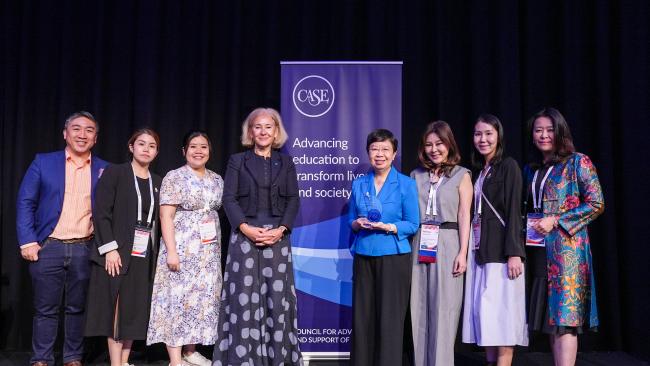
The recognition underscored a broader institutional view increasingly evident at SMU: that alumni relations are not peripheral to a university’s identity, but central to its long-term resilience and influence.
Taken together, the honours in Brisbane reflected years of cumulative work across the University community. They also offered a measure of how far SMU has travelled since its founding just over two decades ago, from a new entrant in Singapore’s higher education sector to an institution defining its influence on a larger stage.
In her acceptance speech, Prof Kong reflected on how advancement work extends beyond fundraising to stewardship, trust, belonging, and helping students thrive long after admission. She also spoke about universities as communities built through enduring relationships across generations of students, alumni, faculty, donors, and partners.
Read Prof Kong’s full acceptance speech here.
See also: SMU President Professor Lily Kong conferred 2026 CASE Asia-Pacific Leadership Award | SMU Newsroom