


SMU leads Asian sustainable finance research at first GRASFI Asia Conference
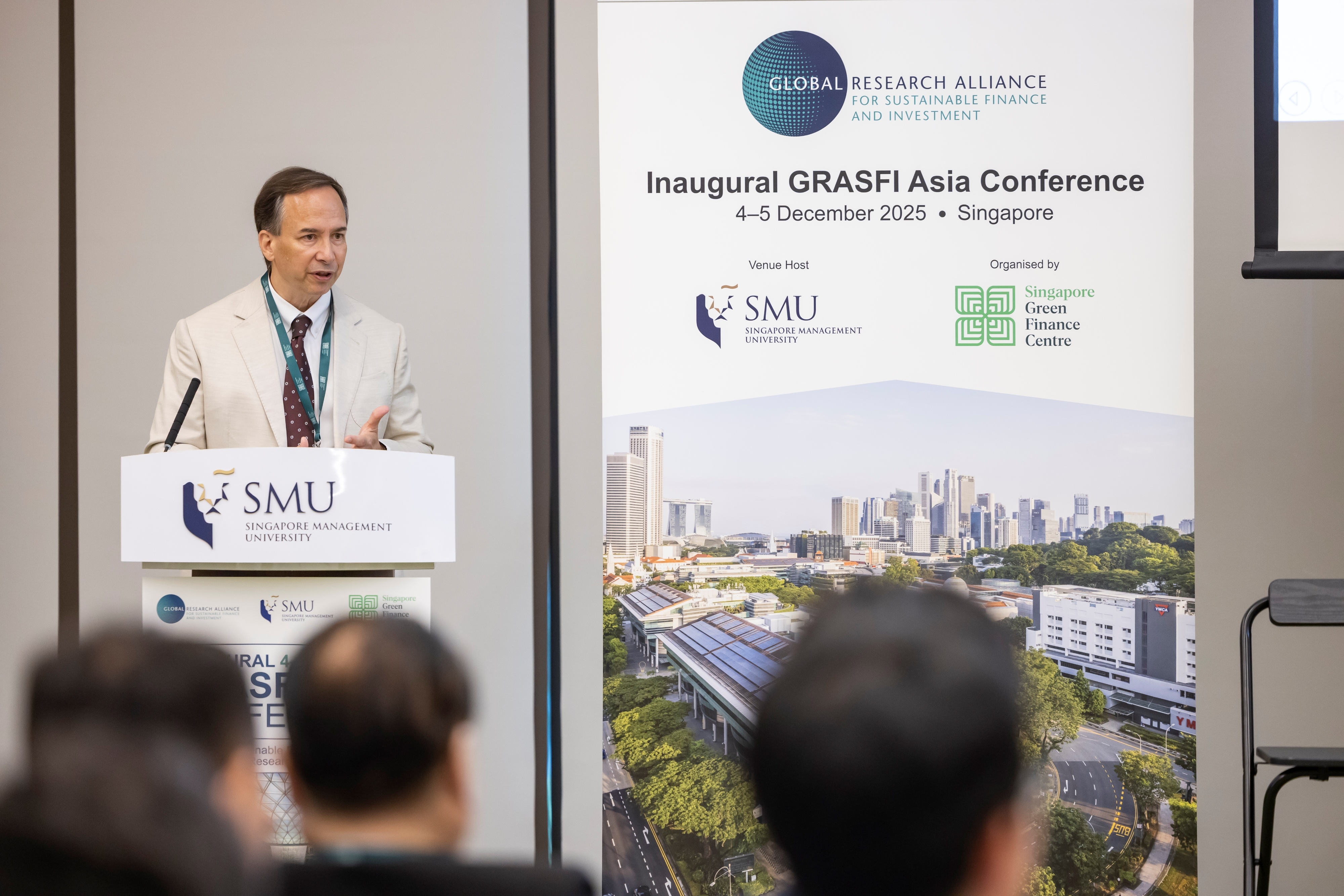
Researchers, policymakers, and industry leaders gathered at SMU for the inaugural Global Research Alliance for Sustainable Finance and Investment (GRASFI) Asia conference, underscoring the growing need for Asia-specific research to support credible climate and nature finance.
Held on 4 and 5 December 2025 and hosted by the Singapore Green Finance Centre (SGFC) at SMU, the GRASFI-Asia Inaugural Conference recognised that Asia requires its own evidence base to support financing decisions. Much of the existing research in sustainable finance remains centred on the US and Europe, even as capital requirements in Asia are rising sharply.
In his opening remarks, SMU’s Vice-President for Impact Professor Scott Fritzen noted that rigorous and regionally grounded evidence are essential for practitioners and policymakers who must assess risk and returns in markets with different institutional arrangements and development priorities. He pointed to Southeast Asia’s significant needs in adaptation, transition, and nature protection, as well as a more cautious global policy setting in which countries weigh competitiveness and economic security.
Fritzen added that universities have an important role in bridging academic evidence with practice, citing SMU’s focus on translation and policy design.
Translating research into practice
SGFC, anchored at SMU with the support of the Monetary Authority of Singapore and global financial institutions, convened the conference to encourage closer dialogue between research and industry.
SGFC Executive Director Nikki Kemp explained that the Centre had been established to connect scholarly analysis with financial decision-making. “SGFC and GRASFI represent an aligned vision for global research excellence for sustainable finance innovation and localised knowledge sharing,” she said. Kemp urged researchers to pay attention to industry needs, noting that specific questions from practitioners often signal areas where more evidence is required.
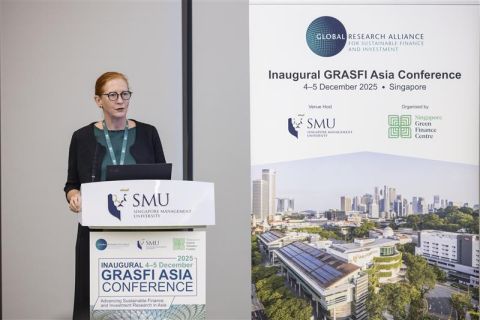
The conference reflected SMU’s broader interest in building capabilities for sustainable finance across the region, both through research and executive education.
Recent research from SMU and partners
Presentations from SMU and partner institutions highlighted how policy developments and market structures in Asia are shaping financial outcomes:
- Biodiversity Policy and Markets: Professor of Finance Hao Liang, SGFC Co-Director, presented research examining how the Kunming-Montreal Global Biodiversity Framework affected Chinese equities. Firms displayed negative abnormal returns when the policy was introduced, with companies linked to conservation subsidies facing greater penalties. The findings suggest that investors are beginning to recognise biodiversity policy as being financially material and highlight analytical tools that can support transition finance assessments.
- Retail Investment Behaviour: SMU PhD candidate Yanlin Bao analysed account-level data from an Indian bank to study how retail investors weigh financial performance against sustainability objectives. The research found that when performance costs become apparent, retail investors adjust allocations, indicating that voluntary participation in green products may require better information and market structures.
- Carbon Pricing and Economic Outcomes: Research co-authored by SMU Professor of Finance Hong Zhang examined carbon pricing and its consequences at the firm level. The study found that pricing reduces emissions without harming aggregate output, but imposes financial costs on high-emission firms, thus raising policy questions about revenue recycling and support mechanisms.
These studies reinforced the conference’s central theme: Asia benefits from empirical work grounded in regional data rather than external insights that fail to reflect Asian market realities.
Discussions on policy and implementation
Conference panels examined the practical aspects of climate and sustainability finance. In one discussion, Calvin Quek from the Oxford Sustainable Finance Group emphasised the importance of financial position in shaping influence. Investors with minority stakes, he noted, cannot direct corporate decisions in the same way as lenders or private equity owners, and strategies must reflect this.
A closing panel on the “winter” of sustainability debated how companies in Asia can maintain momentum amid changing political and fiscal conditions globally. Speakers agreed that firms increasingly need to consider environmental and social resilience alongside climate mitigation. They also observed that limited fiscal capacity in advanced economies may restrict international support for developing markets.
Bey An Lim, Head of the Sustainability Office at the Monetary Authority of Singapore, stressed that sustainability should be communicated as both an opportunity for growth and a requirement for long-term resilience. She noted that progress often depends on collective action across sectors and pointed to transition credits for fossil fuel plant retirement as an example of mechanisms under consideration.
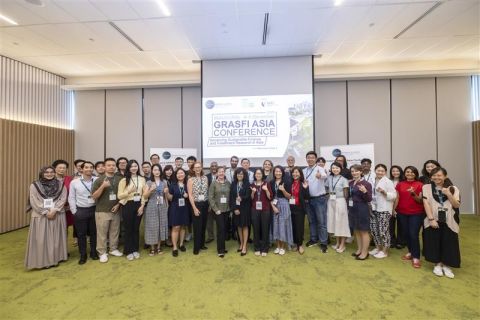
A platform for Asia’s sustainable finance leadership
The discussions across both days made clear that Asia’s sustainable finance agenda will be shaped not only by capital and policy, but also by the quality of evidence informing those decisions. SMU’s role — through SGFC, partnerships, and education — places it at the centre of that effort.
As demand for credible analysis increases, the establishment of GRASFI Asia with SMU marks a step toward building regional research capacity that can inform both financial markets and public policy in the years ahead.
See also: