

SMU grads have strong employment rates despite cautious climate
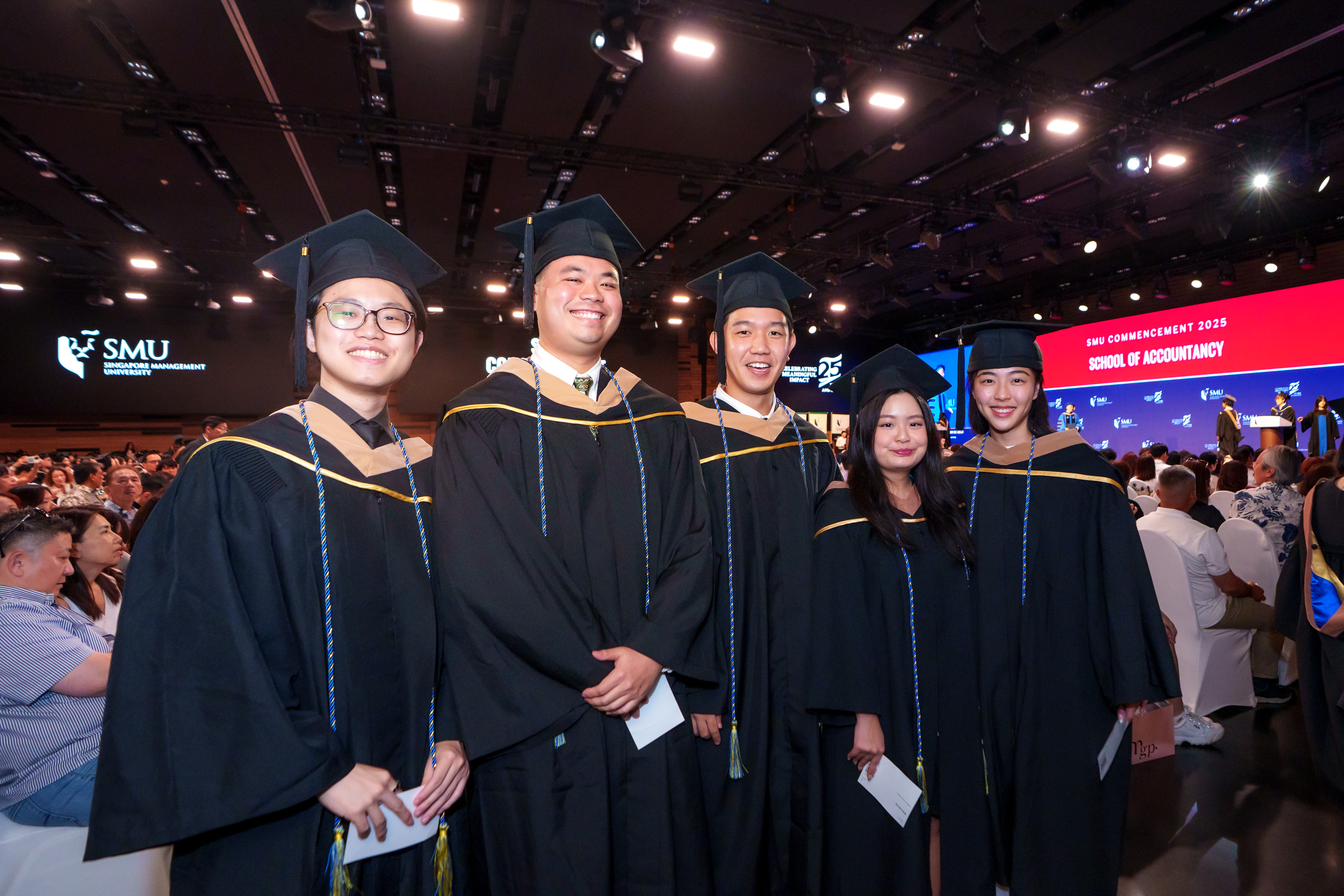
Graduates from Singapore Management University (SMU) continue to achieve strong employment outcomes despite a more cautious hiring environment, with 91.4% securing employment within six months of graduation.
The findings were released on 5 March 2026 through the Joint Autonomous University Graduate Employment Survey (JAUGES) 2025, which tracks employment outcomes across Singapore’s autonomous universities.
Of SMU’s 2,331 graduates in the Class of 2025, 1,710 responded to the survey, representing a 73.4% response rate.
Under the newly introduced secured employment rate indicator, which includes graduates who have accepted job offers but have yet to begin work, as well as those starting their own ventures, SMU recorded a secured employment rate of 91.4%. The overall employment rate stood at 87.1%, with 79.8% of graduates securing full-time permanent roles.
Graduates also continued to command competitive salaries. The average gross monthly salary rose to $5,116, up from $5,057 the previous year, while the median gross monthly salary increased to $4,747, compared with $4,600 in 2024.
Securing employment before graduation
A defining feature of SMU’s undergraduate education is its mandatory internship programme, which provides structured exposure to professional environments before graduation.
The survey results highlight the role these internships play in shaping early career outcomes:
- 30.9% of graduates in full-time permanent employment are working, or have worked, at the same company where they interned.
- 16.4% reported receiving job offers from their host companies but chose not to accept them.
Taken together, this indicates that nearly half of SMU graduates received full-time employment offers during or after their penultimate-year internships, reflecting strong employer confidence in SMU graduates.
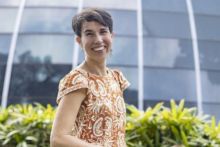
For example, Kylie Oh, who graduated from the Bachelor of Social Sciences with a major in Politics, Law & Economics, tested six industries during her four years at SMU to explore how different sectors solve problems and create value. In addition, the exposure helped her build adaptability and commercial judgement early in her career.
“Each organisation had its own culture, pace and expectations,” she said. “I had to quickly understand new problem statements and navigate ambiguity with confidence,” she said.
Her final internship at Visa turned into a full-time offer under the company’s competitive two-year Leadership Associate Programme, which rotates graduates across four business functions—a role that she chose for its structured exposure to the global payments ecosystem, solid mentorship and clear progression pathways.
Another SMU graduate whose internship resulted in a job offer is C Karttikraj from the Bachelor of Accountancy programme. In 2023, his five-month internship at Grant Thornton Singapore Private Limited gave him front-line exposure to how companies were rebuilding after the Covid-19 downturn.
He was quickly immersed in client engagements, which he was prepared for thanks to SMU’s holistic education and diverse campus experiences.
“SMU exposed me to different perspectives and encouraged me to keep learning,” he said. “It prepared me to engage people and adapt in the workplace.”
Other graduates such as Crystal Yong did not move on to full-time positions at their internship companies, but nonetheless secured employment before graduation with support from SMU. The Bachelor of Business Management in Marketing (Marketing Analytics) graduate had initially expected to go into a career in data-driven marketing, but found her true calling during her time at SMU.
Thanks to internships, including overseas placements under Singapore Management University’s ASEAN Internship Programme, Crystal fell in love with a career that helps her design meaningful travel experiences across cultures.
With tailored career counselling from SMU’s Dato’ Kho Hui Meng Career Centre, Crystal secured two job offers before completing her degree, choosing a Management Associate role at Resorts World Sentosa, where her work in operations planning provides insights into end-to-end tourism experience design.
She said: “SMU’s internship culture and industry-linked curriculum really helped to build my confidence, in particular my ability to communicate effectively with people from around the world.”
Continued demand across key sectors
Employment patterns remain consistent with previous surveys. Finance and Insurance, Legal, Accounting and Auditing, and Information and Communication continue to be among the sectors employing the largest share of SMU graduates.
Notably, 61.4% of graduates in full-time permanent employment received job offers before graduation, a 1.3 percentage point increase compared with the previous cohort.
These outcomes suggest sustained employer demand for graduates with strong analytical training and practical industry exposure.
Preparing graduates for a changing economy
SMU leaders say the university is strengthening efforts to prepare students for an economy shaped by technological transformation.
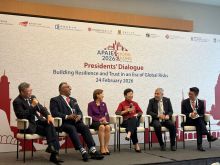
The University’s Provost and Kwan Im Thong Hood Cho Temple Chair Professor of Inter-Religious Studies and Harmony, Professor Alan Chan, said:
“While hiring conditions are becoming more cautious as organisations manage uncertainty and accelerate automation, this is precisely where SMU’s learning model proves its strength.
“We are intensifying our efforts to equip our students with essential human-centred competencies, such as strong critical thinking and communication skills as well as a high degree of AI fluency, which are vital to flourishing in a rapidly changing work environment. We will further enhance experiential and interactive learning that is the hallmark of an SMU education.”
SMU integrates academic study with real-world engagement through programmes such as SMU-X, Work Study Electives, and its mandatory internship framework. Students also participate in community service and global exposure programmes, designed to strengthen adaptability, cross-cultural awareness and social responsibility. All graduating students also receive a co-curricular transcript that gives employers deeper insight into the skill sets and competencies students have developed through co-curricular activities—complementing their academic transcripts.
Professor Chan added: “More internship and global education opportunities will be provided, with a sharpened focus on preparing students to be Asia-ready and future-ready. Our goal is to ensure SMU graduates remain resilient, adaptable, and highly competitive, not just for today’s roles, but for the evolving careers of tomorrow.”
As Singapore’s economy evolves, SMU continues to strengthen partnerships with industry to ensure graduates develop the applied skills, digital capabilities and adaptability required in an increasingly technology-driven labour market.
Recent survey findings indicate that, despite a more conservative approach to hiring, SMU graduates are still set up for career success and are able to navigate changes in their professional paths. In addition to assisting students throughout their undergraduate studies, SMU also offers ongoing career coaching to its alumni.