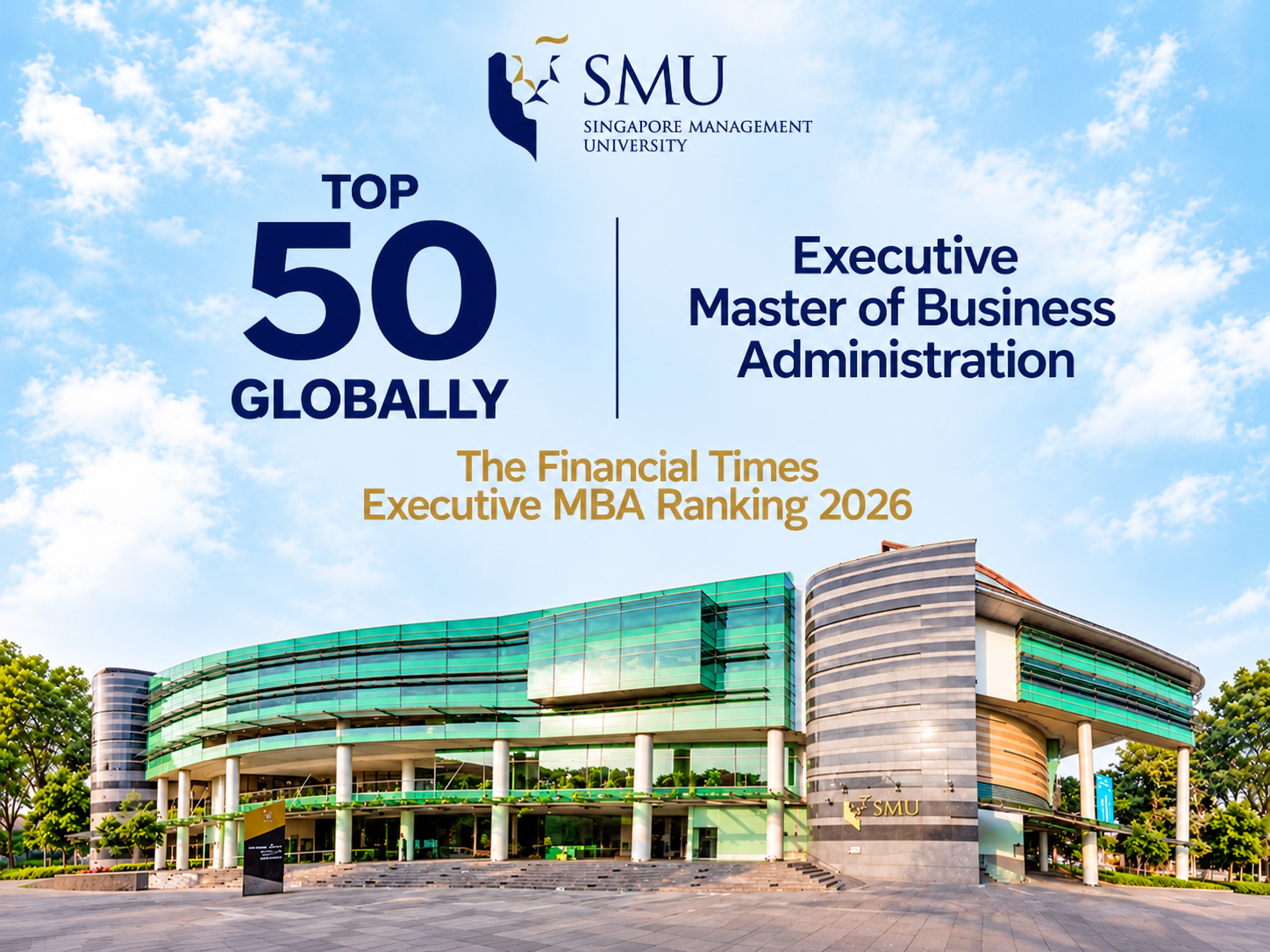
SMU’s Executive Master of Business Administration (EMBA) programme has entered the world’s top 50 in the Financial Times Executive MBA Ranking 2026.
The programme climbed nine places from its last ranked position in 2024 to place 46th globally. Offered by SMU Lee Kong Chian School of Business, it also achieved its highest positions to date in two categories: International Course Experience and Career Progress.
The SMU Executive MBA rose 18 places to rank ninth globally for International Course Experience and advanced 27 places to 42nd for Career Progress. The results reflect two considerations facing experienced professionals: developing the ability to work across international markets and continuing to progress in their careers.
An international perspective on leadership
For executives working across borders, decisions made in one market can have different implications in another. Business practices, economic conditions and cultural expectations vary, requiring leaders to understand the contexts in which their organisations operate.
International learning is therefore a central component of the SMU Executive MBA. Participants gain first-hand exposure to business environments in the United States, China and Europe, where they meet leaders and organisations operating in different markets.
The programme’s ninth-place position for International Course Experience places SMU among the world’s top 10 in a category that measures the proportion of required teaching conducted outside a business school’s home location.
“Today’s senior leaders need to understand how business is conducted across different markets, cultures and economic environments,” said Dr Ang Ser Keng, Academic Director of the SMU Executive MBA programme.
“Our EMBA is designed to give participants that breadth of perspective. Through learning experiences in Asia, Europe and the United States, they engage with different business ecosystems, exchange perspectives with leaders and organisations across markets, and bring those insights back to their own leadership contexts.”
He added that this international exposure, combined with the experience of participants’ classmates, helps prepare executives to lead in an increasingly interconnected world.
Participants in the programme have an average of 20 years of workforce experience. Their varied industry and management backgrounds contribute different perspectives to classroom discussions.
The programme’s modular structure also recognises the demands of executive careers. Intensive teaching blocks, international immersion experiences and practical projects allow participants to pursue their studies alongside their professional responsibilities.
Progress beyond the classroom
The programme’s other major improvement came in Career Progress, where it climbed 27 places to rank 42nd globally.
This measure compares the seniority of alumni and the size of their employing organisations before and after their studies. The latest result indicates that graduates made stronger progress on these measures than the alumni assessed when SMU was last included in the ranking.
Alumni also rated the programme’s professional network more highly for career opportunities, recruitment, entrepreneurship and access to events. Such connections can be valuable to experienced executives whose next move might involve assuming greater responsibilities, changing organisations or exploring another industry
“We are deeply encouraged by our gains in Career Progress and International Course Experience, as they reflect two things that matter greatly to experienced executives: continuing to grow as leaders and developing the perspectives to operate effectively across markets,” said Dr Ang.
Learning from experienced peers is another important part of the programme. The classroom brings together executives whose careers span a range of industries, organisations and business challenges, allowing participants to learn from perspectives beyond their own professional environments.
Looking beyond the rankings
The Financial Times Executive MBA Ranking assesses programmes using information provided by business schools and their alumni. Its criteria cover career outcomes, diversity, international experience, research, and environmental, social and governance considerations.
In 2026, alumni-based criteria account for 52 per cent of the overall assessment, with information supplied by the schools making up the remaining 48 per cent.
International Course Experience is calculated using the proportion of required classroom teaching hours conducted outside a school’s home location, including in-person, virtual and hybrid learning. Career Progress measures changes in alumni seniority and the size of their employing organisations.
These measures do not capture every aspect of an executive’s learning experience, nor do they establish how much of an individual’s career advancement can be attributed to a programme. They can, however, help prospective participants compare particular features of executive education across institutions.
The entry into the global top 50 represents a milestone for the SMU Executive MBA, particularly alongside its advances in international learning and career outcomes.
For executives considering an EMBA, rankings can provide a useful starting point. The more important question is what they hope to gain from the experience, whether that is understanding unfamiliar markets, learning from fellow leaders or preparing for the next stage of their careers.
See also: SMU Executive MBA enters global Top 50 in Financial Times ranking | SMU Newsroom