

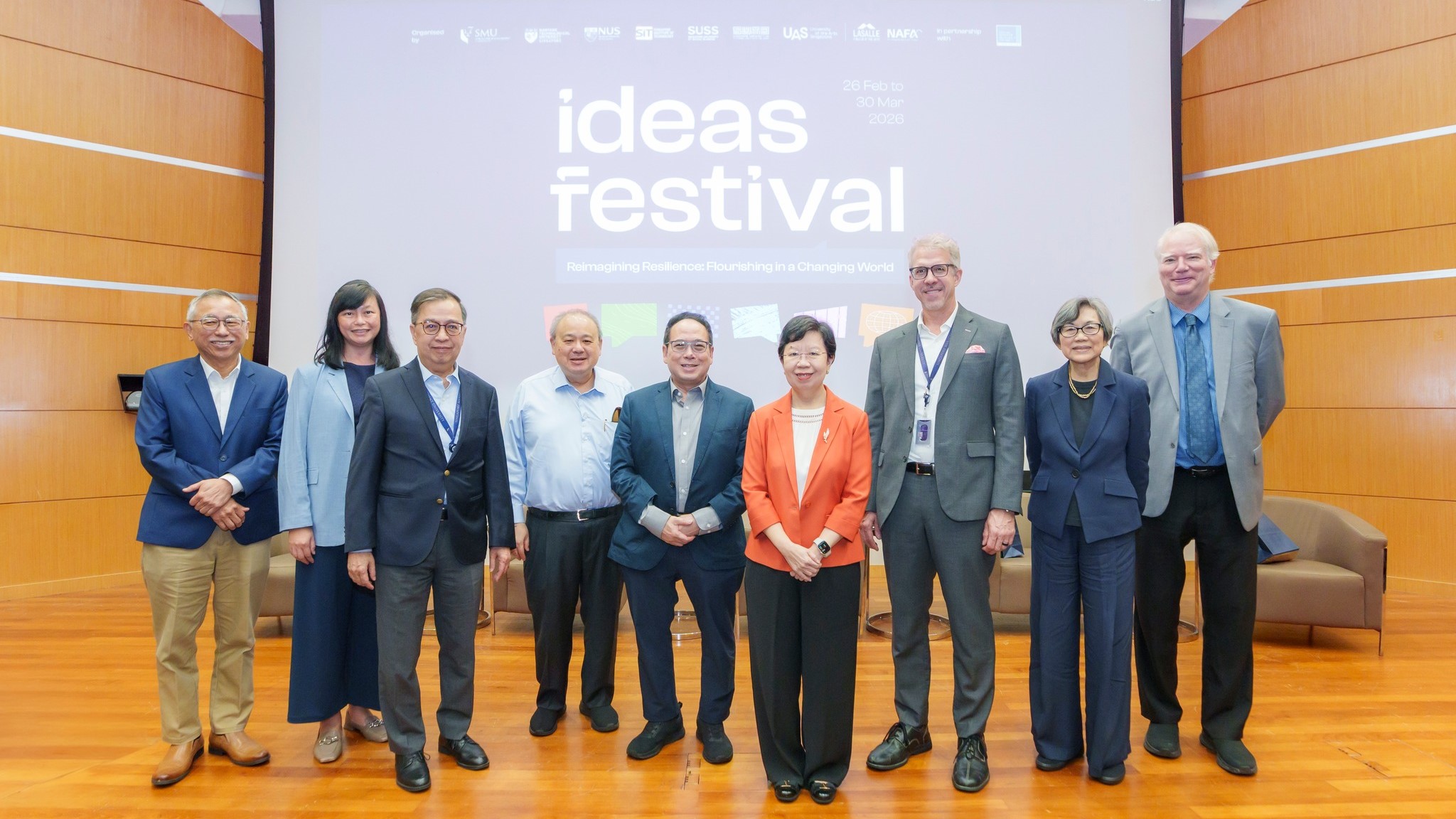
What does it take to stay steady – and even thrive – when the rules of work, technology and society keep shifting? That question set the tone at SMU Ideas Festival 2026, co-organised by SMU’s School of Social Sciences, which opened on 26 February at the Mochtar Riady Auditorium with an energising call to rethink resilience for a changing world.
Bringing together policymakers, academics and sector leaders, the launch event – Reimagining Resilience: Flourishing in a Changing World – also marked the start of a month-long line-up exploring resilience across social, economic, and technological contexts.
Positioning research for public impact
In his opening remarks, Mr Peter Ho, Chairman of the Social Science Research Council, underscored the importance of translating research into practical outcomes – especially as disruptions across economies, public health and technology become more pronounced.
Following up, SMU Provost Professor Alan Chan reinforced this direction, describing the festival as a platform for interdisciplinary exchange and for “bridging disciplinary minds”. He emphasised that collaboration must retain disciplinary rigour, noting that strong outcomes depend on both depth and coordination across fields.
Aligning policy, research, and society
In his keynote address, Minister for Education Mr Desmond Lee said, “This year’s focus on resilience amidst a changing world is timely. We live in times of great complexity and uncertainty. Amidst these changes, social science and humanities research can help us to make sense of what’s going on, chart our course, identify trends, avoid pitfalls, and seize opportunities.”

He pointed to three areas of focus: climate adaptation, the impact of artificial intelligence on jobs, and an ageing population, underscoring the need for policies informed by research and supported by public trust, especially in these areas.
He also highlighted the importance of strengthening local research capabilities to inform programmes that safeguard well-being and social stability.
Reframing resilience
A key theme of the opening session was the shift from viewing resilience as “recovery” to understanding it as “sustained capability”.
Ambassador-at-Large with the Ministry of Foreign Affairs Dr Chan Heng Chee, who is also the Singapore University of Technology and Design Honorary Professor at the Lee Kuan Yew Centre for Innovative Cities, framed this through urban resilience, noting that “…a resilient city is able to survive a traumatic blow to its physical structure, its economy, and its social fabric. The resilient city bends, but it does not break. It absorbs without shattering."
This perspective positions resilience as both structural and social, shaped by systems, institutions, and the quality of relationships across communities.
Ensuring relevance beyond academia
The launch day also saw a panel discussion that brought together leaders from across the social sciences and humanities, including SMU President Professor Lily Kong, SMU Dean, School of Social Sciences, Professor Kenneth Benoit, National University of Singapore Professor Kenneth Dean, and Nanyang Technological University (NTU) Professor Euston Quah.

Professor Benoit set the tone by stressing the importance of impact: “If what we’re doing doesn’t have impact… then what value is there?”
Panellists discussed how the social sciences complement STEM fields by clarifying trade-offs, interpreting human behaviour, and informing policy decisions, particularly in areas affected by rapid technological change.
The panel was followed by a Q&A session that extended the discussion to the role of the arts and the implications of artificial intelligence.
NTU Professor Kwok Kian Woon raised the place of the arts within the broader research landscape, with panellists affirming its importance in shaping how societies interpret change and define shared values.
On AI, participants agreed on the need to strengthen critical thinking and ethical awareness, ensuring that students are equipped to use technology effectively without compromising core cognitive skills.
Different facets of resilience
The launch event set the foundation for the remaining eight festival events across March, which addressed topics such as mental health, environmental change, legal systems, and the future of work across five thematic categories:
- Resilience and Mental Wellbeing
- Adapting to Change I: Urban, Social, and Cultural
- Adapting to Change II: AI and Emerging Technologies
- Regional, Policy, and Global Resilience
- Careers, Education, and Skills for the Future
Highlights included a presentation on the SMU Resilience Framework, which shifts the approach to student wellbeing from intervention to cultivation.
The Speculative Future Frames Workshop invited participants to examine assumptions about higher education and prototype alternative models through design-based approaches.
Additional panels explored how law can remain a stabilising force in the age of AI, and how work is evolving in response to technological disruption. An interactive session introduced students to career pathways in the social sciences, while a guided tour traced key milestones in Singapore’s socio-economic development.
Across the festival, a consistent message emerged: resilience requires coordination across research, policy, and society. It extends beyond recovery from disruption to include preparation for change, institutional strength and sustained public trust.
For SMU, co-organising the Ideas Festival through the School of Social Sciences – and contributing thought leadership through our faculty, leaders, and initiatives like the SMU Resilience Framework – reflects a broader commitment to making a meaningful impact beyond campus. By convening diverse voices and translating research into practice, SMU continues to advance ideas that strengthen communities, inform policy and help society navigate change with greater confidence.