

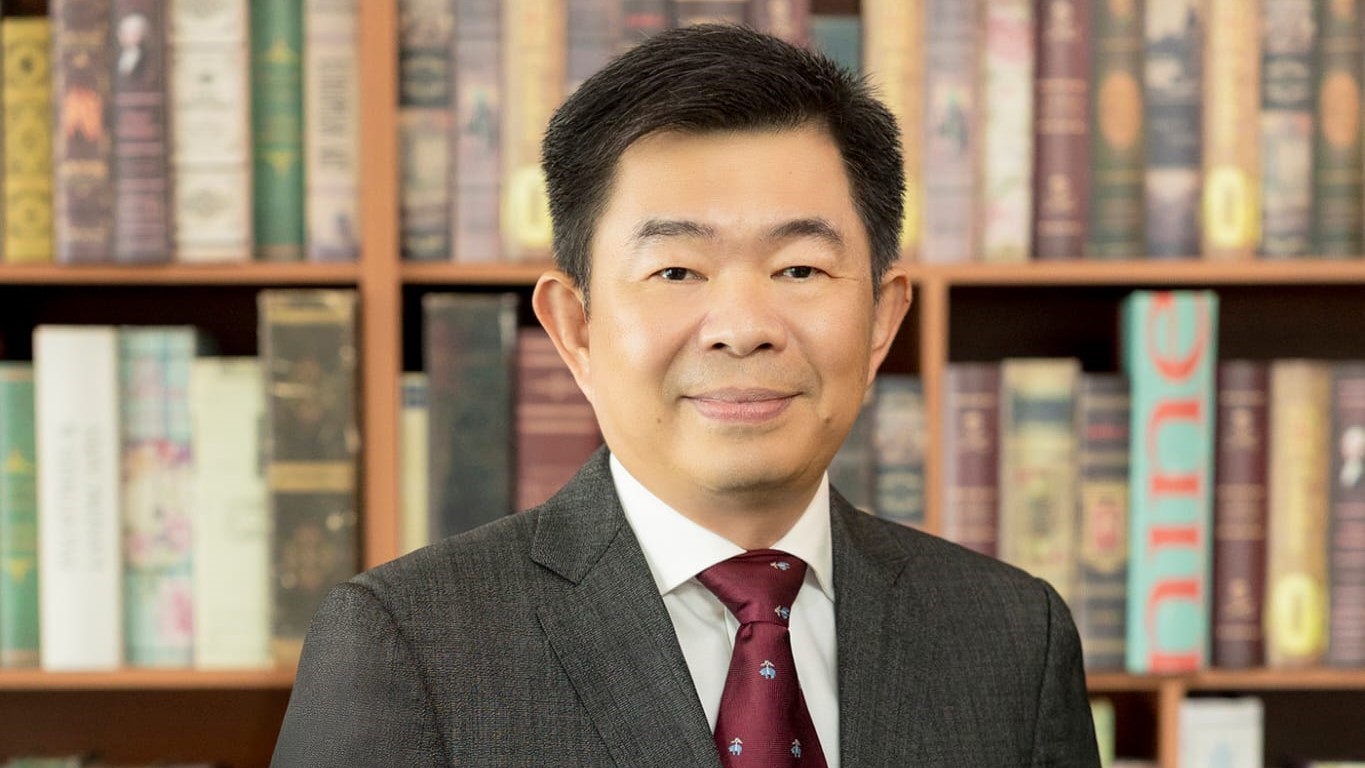
SMU PhD in Business (General Management), alumnus (2017) Dr Tan Boon Heon didn’t take the usual MBA route at the peak of his pharmaceutical career. Instead, he chose a part-time doctorate at SMU to prepare for life’s “half-time” — and a second act built on purpose. As a result, he is now CEO of HCA Hospice.
After 12 years navigating the executive suites of the pharmaceutical industry, Dr Tan Boon Heon found himself restless. At a juncture where his peers were beginning to map out their retirements, he was searching for a career catalyst.
He already held bachelor’s and master’s degrees in bioengineering and the conventional path of an MBA, an obvious credential for a managing director, offered little intellectual appeal.
“I’m already in senior management,” he noted. “I don’t really need an MBA.”
The pivot arrived during a SMU event in Shanghai with Annie Koh, Professor Emeritus of Finance at SMU, who was then Dean of Executive Education. She introduced him to the University’s part-time PhD in Business (General Management), a rigorous academic track that demanded far more than the standard corporate curriculum.
“I did not believe that I was just going to retire at 55,” he said.
“In retrospect, I was actually preparing for the second half of my life. What else can I do that’s going to propel me further, that’s going to take me on a different trajectory?”
A degree to open new pathways
While Dr Tan had intended his degree to act as a bridge to his second act, the corporate world and COVID-19 pandemic had different plans. After completing his doctoral work on ethical leadership in 2017, a wave of industry redundancies upended several of the senior leadership roles he took on.
“What the SMU PhD training really did is to remind me of all that has to be considered when faced with a difficult decision,” reflected Dr Tan.
Following a third redundancy, the SMU Alumni Mentor took a six-month sabbatical to evaluate his trajectory. He considered this his "half-time", a moment to strategise his next play before returning to the field. And when the chief executive position at HCA Hospice presented itself in 2025, the alignment was undeniable.
As Singapore’s largest home hospice care provider, HCA provides free medical and psychosocial support, along with bereavement services for patients with a prognosis of less than a year, and their family members. The role synthesised his operational expertise, a desire to remain in Singapore with his family, and the ethical focus of his SMU doctorate.
“The purpose of me going to work every day for the past 20 years has always been to bring the innovations of the healthcare industry to people who need it.
“In the pharmaceutical industry, that’s what I did. And here, in HCA, I can’t imagine a patient group that needs this more than anyone.”
Translating corporate strategy to human impact
While the corporate sector is driven by profit, in palliative care, the metrics are absolute: the alleviation of human suffering and the preservation of their dignity, where possible.
“I’m measuring the real impact we have on people, how many people we help, how many people say they were so happy with the service we provided [their loved ones], how many people – in our case – got to die at home, according to their wishes.”
Operating a hospice in Singapore presents unique cultural hurdles, primarily because the topic of death remains a taboo. Of the approximately 25,000 people who die in the city-state annually, HCA journeys with about one in five, according to Dr Tan; supporting nearly half of all home deaths. He noted that when hospital clinicians first suggest hospice care, families often reconsider the option out of a lack of awareness.
“We need to equip the clinicians in the hospitals or social workers with more information about what hospices do so that they can also share that information accurately and persuasively with the families of patients,” said Dr Tan.
Lessons from the SMU PhD
The most enduring asset Dr Tan gleaned from his doctoral research was a framework for navigating ambiguity. In palliative care, every decision requires juggling multiple, often conflicting, perspectives.
He pointed to a common ethical dilemma: a frail patient who insists on walking unaided but presents a severe fall risk.
"How far do you go to make sure that patient doesn't fall?" he asked. "You could restrain them to protect them from harm, but you want them to have their dignity and their independence. There's never a black-and-white answer."
Navigating these grey areas requires constant calibration. Indeed, Dr Tan considers himself a student of his own staff, absorbing their daily case discussions and sharing his insights in return. It is a dynamic, evidence-based exchange that mirrors the pedagogical style he valued during his doctorate.
"I was really impressed by how we taught at SMU, the fact that we focused a lot on a very practical curriculum and brought in a lot of people from the outside to share real-life experiences," he noted.
"I felt that really prepared our students very well for what comes next."
His connection to the University extends well beyond graduation, having served as an adjunct lecturer and frequent guest speaker. Today, he mentors current students and sits on the executive committee of the Leading Executives and Directors (LEAD) alumni group.
When advising undergraduates torn between the immediate financial security of the corporate sector and the calling of non-profit work, his counsel is pragmatic.
"First, I would say you don't have to choose yet," he said.
"It's natural, at the beginning of your career, to worry about establishing a foundation, to gain a lot of experience, to worry about your financial stability."
He encourages SMU students to volunteer in the interim, reminding them that a career is long and the corporate playbook can always be rewritten at "half-time."
"You don't really have to precisely know where you want to go, but you need to be headed in the right direction," Dr Tan concluded.
"And the fact that you are in SMU already means you are headed in the right direction."
What is HCA Hospice?
Hospices occupy a highly specialised space in the medical ecosystem, providing dedicated end-of-life care.
"When our patients come to us, they have a prognosis of less than one year, and typically, they would need a full-time caregiver," Dr Tan explained.
HCA Hospice caters to individuals who wish to spend their final days at home but require professional medical intervention. The organisation brings the clinic to the patients, deploying doctors, nurses, medical social workers, and trained volunteers directly to their doors.
For patients who remain relatively mobile, HCA also operates an in-house day hospice service, offering them daytime engagement while giving their primary caregivers a necessary break. The organisation also offers Star PALS, a home palliative care service for patients up to age 19 with life-limiting conditions.
A career in two halves: a look back at Dr Tan’s professional journey
1996-2000: EDB Life Sciences
2000-2011: Schering-Plough/Merck & Co
2011-2012: Russell Reynolds Associates Executive Director
2012-2013: Biogen Managing Director China and Asia Expansion Markets
2014-2018: UCB Managing Director and Head of Operations Asia Pacific Rim and India
2018-2019: Caregiver Asia Chief Operating Officer
2019: SMU Adjunct Professor
2019-2024: Kyowa Kirin Asia Pacific President
2025: HCA Hospice Chief Executive Officer