


From global dialogue to urban action: SMU calls for a more human-centred vision of resilience
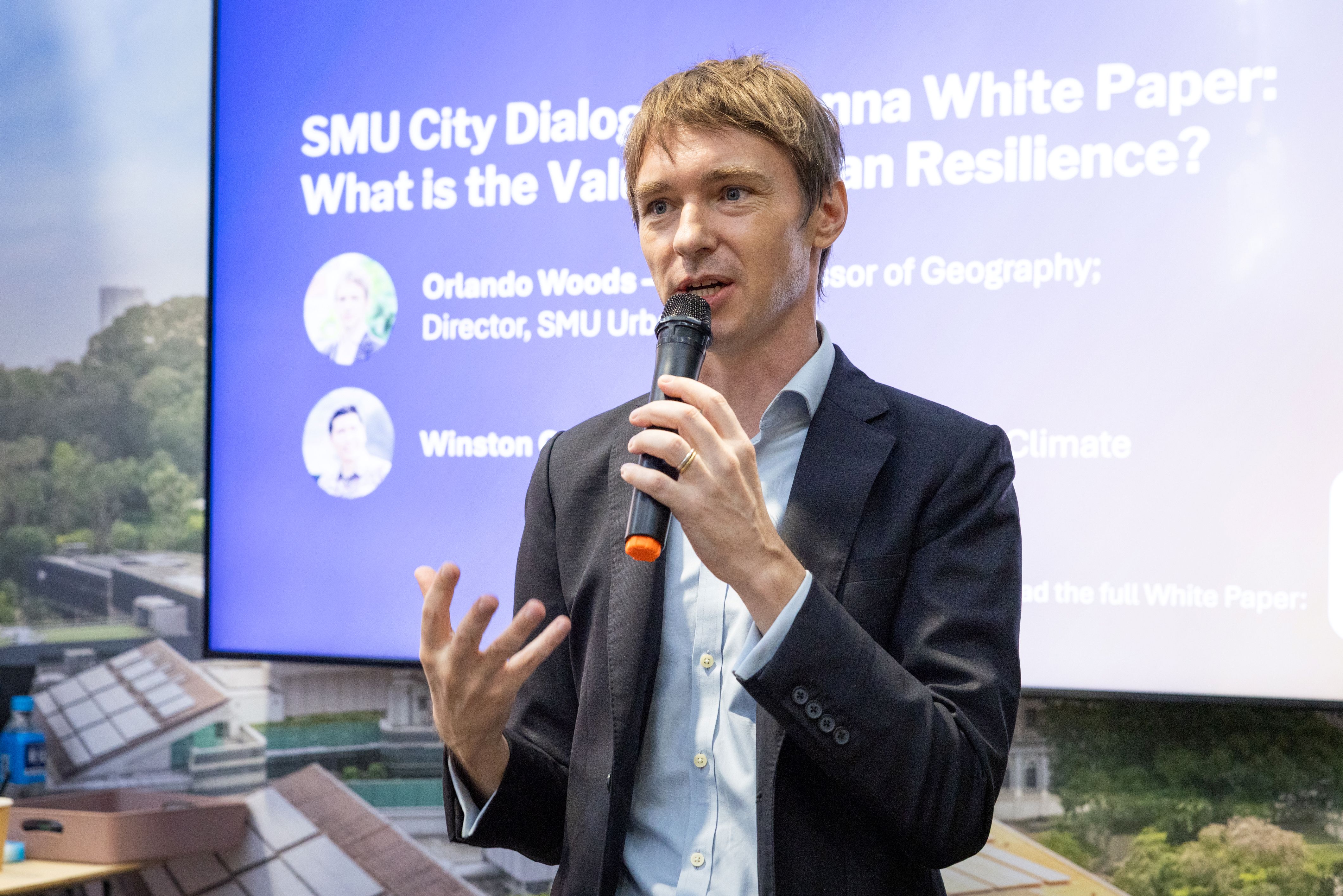
As cities contend with increasingly complex climate and social challenges, SMU is helping to shape how policymakers think about resilience.
Released at the 2026 World Cities Summit (WCS), the University's latest White Paper, “What is the Value of Urban Resilience?”, argues that cities must look beyond infrastructure and economic metrics to place people, equity and lived experience at the centre of resilience planning.
Authored by Professor Orlando Woods, Professor of Geography and Director of the SMU Urban Institute, the paper is timely as communities across Southeast Asia continue to recover from severe floods, earthquakes and extreme heat, while climate-related losses worldwide now exceed USD300 billion annually.
Rather than viewing resilience solely through the lens of engineering or disaster preparedness, the paper asks a broader question: how should cities decide what – and who – they value when preparing for an uncertain future?
From international dialogue to practical action
The paper builds on discussions from the fourth SMU City Dialogues, held in Vienna in July 2025 as a partner event of the Mayors Forum of the World Cities Summit. The forum convened more than 100 participants from 20 countries, representing universities, governments and industry.
More significantly, it reflects SMU's growing role as somewhere that global conversations become practical guidance for policymakers, urban planners and city leaders.
Professor Woods, who is also Associate Dean (Research and Postgraduate Education) at SMU College of Integrative Studies, said: "Urban resilience has long been measured by what we can quantify, such as avoided losses, infrastructure investment, and economic returns.
“However, the crises hitting our cities today are not evenly distributed, and they fall hardest on those least equipped to recover.
He adds: “If we only value what we can count, we risk building cities that are technically resilient but socially fragile. This white paper is a call to hold both the rigour of evidence and the humanity of experience in the same frame – and to ask, seriously, whose futures we are protecting and whose knowledge we trust to do it."
Rethinking what resilience means
Drawing on international case studies and discussions with academics, government officials and industry leaders, the white paper identifies four priorities for building more resilient cities.
First, it argues that resilience should be valued not only through economic returns but also through non-tangible benefits such as trust, social cohesion and stronger institutions.
Second, it calls for communities to become genuine partners in decision-making, recognising local knowledge as essential to effective policy.
Third, it emphasises that resilience must be inclusive, acknowledging that income, gender, disability and citizenship status all influence how people experience and recover from crises.
Finally, it urges cities to use technology responsibly by addressing data gaps, algorithmic bias and the governance of digital systems.
Together, these recommendations present a roadmap for cities seeking to balance evidence-based policymaking with the realities of everyday life.
The White Paper also reflects the principles it seeks to advance. Its recommendations are not the product of a single discipline or institution, but of conversations held during the fourth SMU City Dialogues, where academics, policymakers and industry leaders exchanged perspectives on the future of cities. In doing so, the publication illustrates that trust, inclusion and collaboration are not simply outcomes of resilient cities. They are also essential to developing the ideas that support them.
By translating those international exchanges into practical guidance and presenting them at the World Cities Summit, SMU demonstrates how universities can bridge research and practice while helping shape the future of urban resilience.
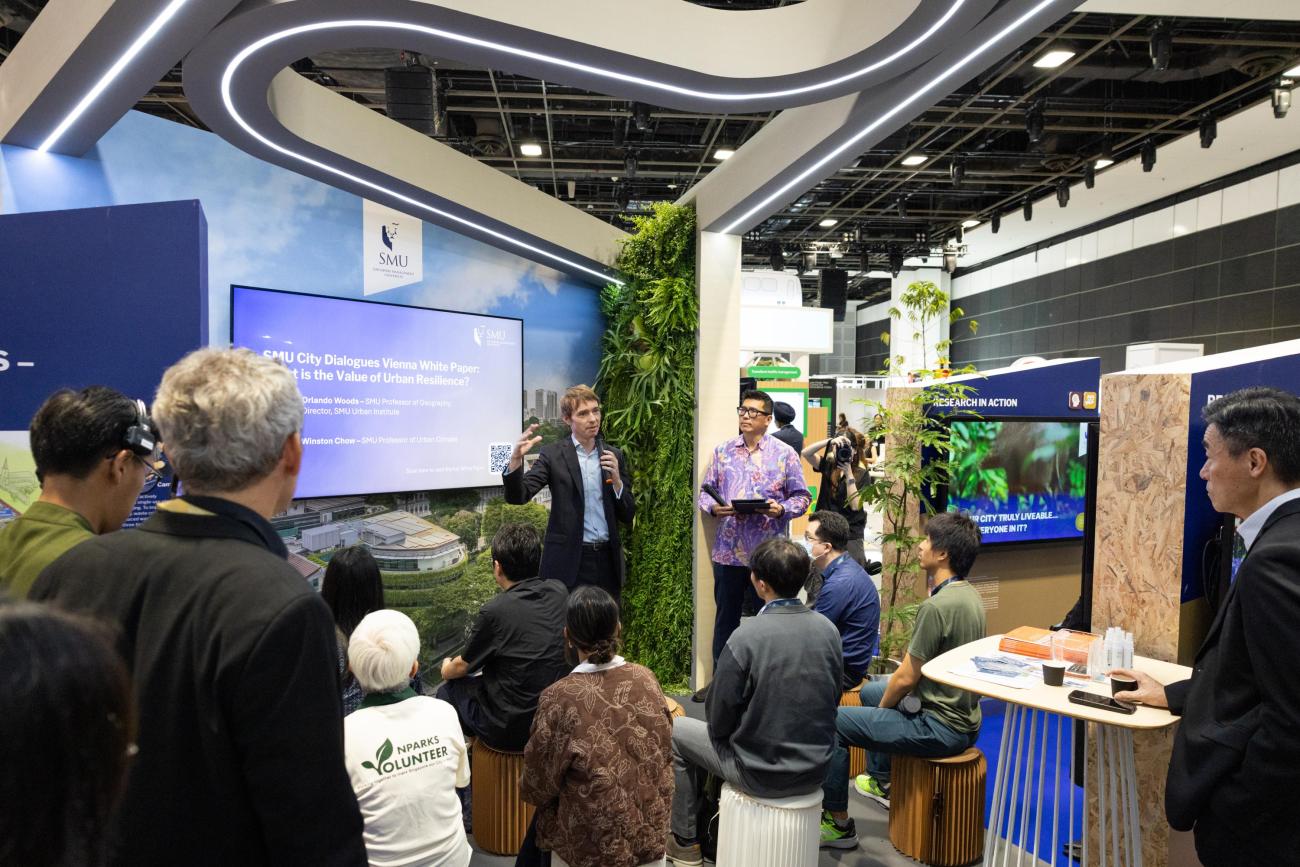
An interdisciplinary contribution to future cities
The paper was one of several projects featured at SMU's pavilion at the World Cities Summit 2026, where the University is showcasing research on the future of cities.
The exhibition spans disciplines ranging from urban geography and economics to sociology, climate science and urban studies. Featured projects examine topics including augmented reality and public spaces, AI's impact on work, ageing and community wellbeing, affordable housing, human-wildlife coexistence, urban heat resilience and sustainable digital infrastructure.
Taken together, these projects demonstrate SMU's interdisciplinary approach to addressing the interconnected challenges facing cities.
See also: