36 Hours for real-world solutions in Singapore-India Hackathon 2026
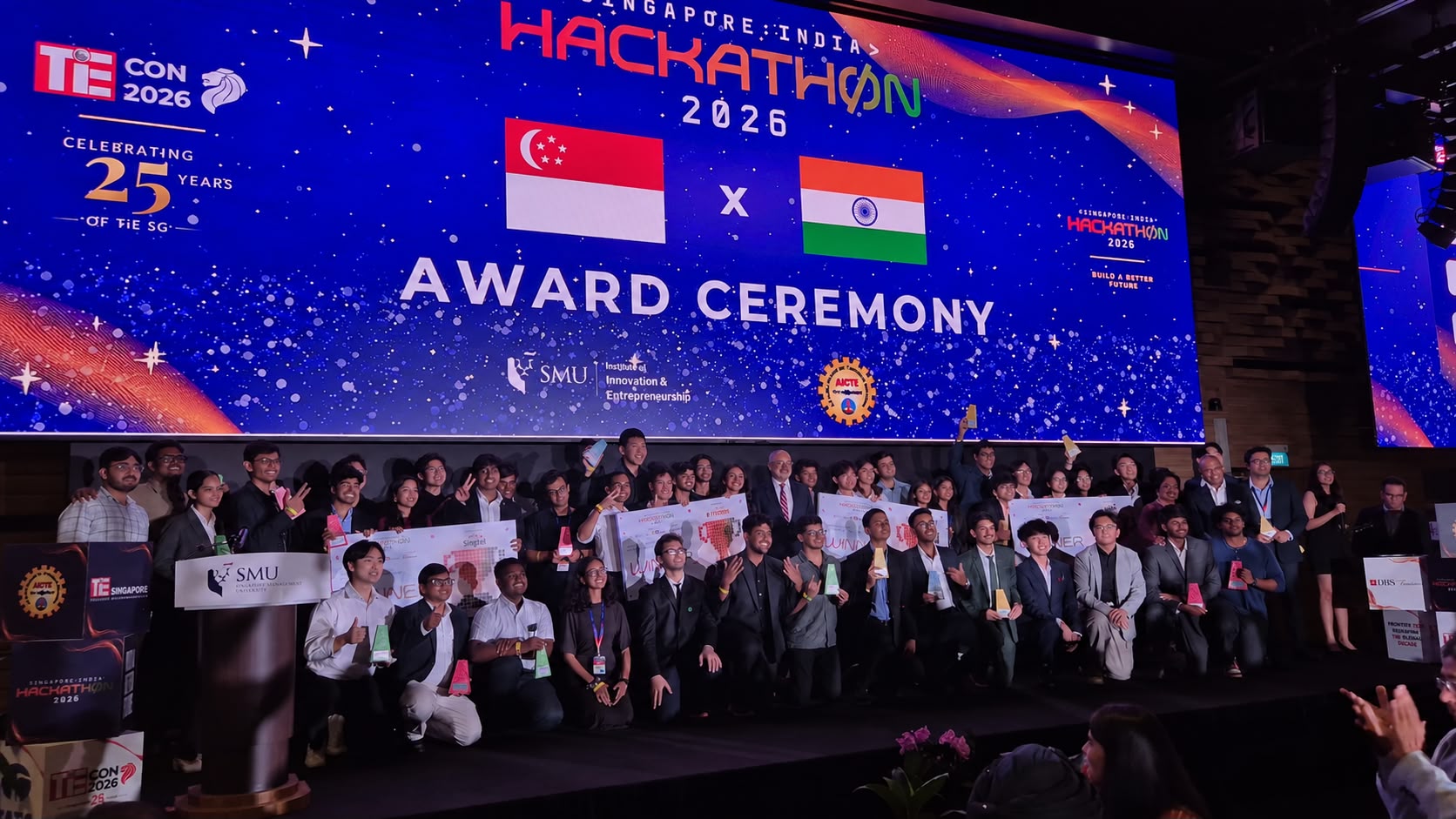
Protecting hawkers against income losses during bad weather, helping businesses identify prospective customers and improving crop planning for smallholder farmers all were among the ideas developed by 120 students at the Singapore-India Hackathon (SIH) 2026.
Over 36 hours, 20 teams from Singapore and India developed and pitched solutions to challenges set by industry and community partners. This fourth edition of the competition, held at SMU from 15 to 17 November, concluded with four teams emerging as winners across the competition's four tracks, sharing S$88,000 in prizes.
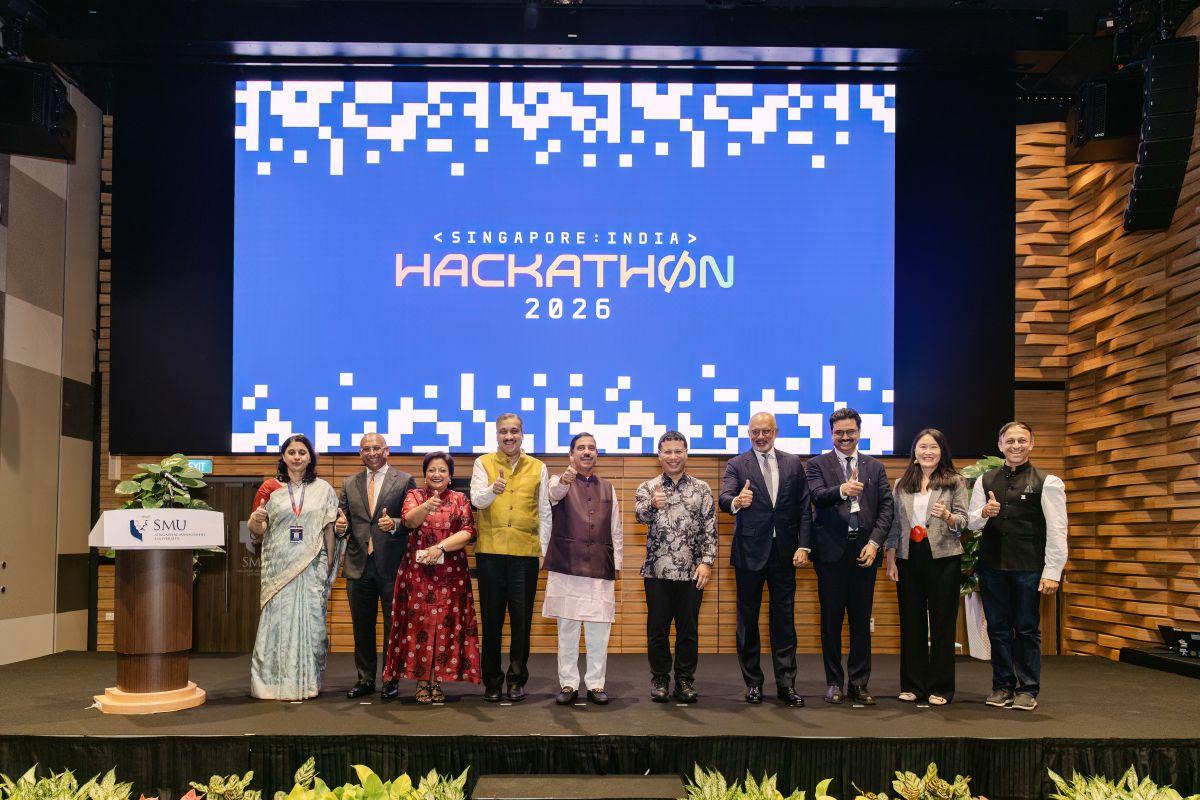
Organised by SMU's Institute of Innovation and Entrepreneurship (IIE), the All India Council for Technical Education (AICTE) and India's Ministry of Education's Innovation Cell, in collaboration with TiE Singapore, the event brought together students from different institutions and disciplines under the theme “Build a Better Future”. It was held in consultation with Singapore’s Ministry of Education, India’s Ministry of Education and the High Commission of India in Singapore.
Four real-world challenges
The competition's four tracks were developed with Singtel, Income Insurance, Singapore's Ministry of Energy, Trade and Industry (METI), and the Singapore Centre for Social Enterprise (raiSE).
In the FinTech and InsurTech track, POINT BLANK took first place with Payung, a proposed bad-weather income protection product for Singapore hawkers. Using public-weather data, it automatically triggers payouts when haze, heavy rain or extreme heat disrupts business, without requiring hawkers to submit claims.
The Emerging Technologies winner, Signal, developed an AI-powered lead qualification tool for Singtel that consolidates information scattered among various sources, such as news, company filings, ownership records and tender data, to identify promising sales opportunities. Its AI agents generate a list of prospective customers, suggest introduction routes and draft messages for account managers .
For the Sustainability and Climate Action track, Holy Crop won with Farmora, a digital platform that helps Indian Farmer Producer Organisations translate buyer demand into coordinated crop plans. It uses local weather and climate data to match farmers and farmland with suitable crops, while giving exporters visibility of expected harvests.
In the Social Innovation and Inclusive Development track, Kawan proposed an ecosystem to help seniors remain active and engaged. Its approach addresses the sustainability of community ageing services, recognises seniors as contributors rather than passive recipients, and seeks to provide support across different levels of frailty.
The standard of participants' work impressed the industry judges. Dhiren Amin, Chief Customer Officer at Income Insurance, said, “For a challenge completed in just 36 hours, the quality of the submissions was highly encouraging.
“Many teams demonstrated a strong grasp of the problem they were solving, backed by well-structured pitches and thoughtful execution. It was equally inspiring to see students from Singapore and India collaborate so effectively. The blend of different perspectives and experiences strengthened the ideas presented and showed how innovation thrives when diverse minds work towards a common goal.”
Collaboration beyond the competition
Working in mixed-country teams meant that many participants had to establish common ground with people they had just met. For Team Kawan's Tarun Shastri, the experience proved as valuable as the project itself.
“When we got our teams, we started meeting online, so we’d already been working together by the time we got here,” he said.
“Once we met in person, there was so much collaboration, and we all took constructive criticism on board. Before we moved on to anything, we made sure we were all on the same page.”
For Piyush Gupta, Chairman of the SMU Board of Trustees, such exchanges help lay the foundation for closer economic ties between the two countries.
At the Gala Dinner where the winners were announced, he said, “Economic corridors are not built by agreements alone – they are ultimately built by people. That is what makes the SIH so compelling. By bringing young innovators from Singapore and India together to combine different disciplines, cultures and ways of thinking around shared challenges, we are fostering the exact relationships on which the next chapter of the Singapore-India corridor can be built.”
Professor Yogesh Singh, Chairman of AICTE, highlighted the importance of sustaining these educational links, saying: “Over four editions, the Singapore-India Hackathon has grown into an important platform for young people from our two countries to learn from one another while working together on challenges that matter to both our societies. Each edition creates new connections between our students, institutions and partners.
“That is the real value of this collaboration: not only the solutions developed during the Hackathon, but the relationships, understanding and opportunities it continues to build between India and Singapore.”
Opening doors to industry and further study
The programme also connected participants with more than 10 companies operating across Singapore and India, including GIC, Singapore Airlines, Singtel and Temasek, to explore project, internship and career opportunities. They also attended TiECon 2026, where entrepreneurs and investors shared their experiences of building and growing businesses.
Teams keen to develop their ideas further can explore mentoring and industry support through SMU IIE, including its Business Innovations Generator (BIG), an equity-free incubator for early-stage start-ups.
The educational opportunities extend beyond the event. The newly established Nupur A. & Amrish Bahadur Scholarship will support four outstanding participants from the 2026 Hackathon and the two preceding editions, regardless of nationality, in pursuing postgraduate studies at SMU. Eligible programmes include the Master of IT in Business, Master of Science in Business AI, and Master of Science in Entrepreneurship and Innovation.
For the students, the competition may have lasted three days, but the experience offers more enduring possibilities: new professional relationships, exposure to different perspectives and opportunities to take their ideas further. For the University, it demonstrated a platform that can bring Singaporean and Indian talent together, with the potential for those connections to continue through education, industry and entrepreneurship.
See also: Singapore-India Hackathon 2026 Names Four Winning Ideas for a Better Future