

SMU brings research, innovation and talent to World Cities Summit 2026
As global leaders gathered in Singapore to discuss the future of cities in the World Cities Summit (WCS), held from 14 to 16 June at the Suntec Singapore Convention & Exhibition Centre, SMU marked its sixth consecutive year as the event’s Patron Sponsor.
Guided by the SMU2030 Strategic Plan, the University contributed faculty expertise, interdisciplinary research and entrepreneurial innovation into worldwide conversations on how cities can remain liveable, resilient and inclusive amid the rapid technological, environmental and demographic change our world is facing.
Faculty contributions across the Summit
SMU leaders and faculty members participated in a series of plenaries, forums and workshops covering topics including urban energy transitions, water resilience, heritage, sustainable finance and AI-enabled urban futures.
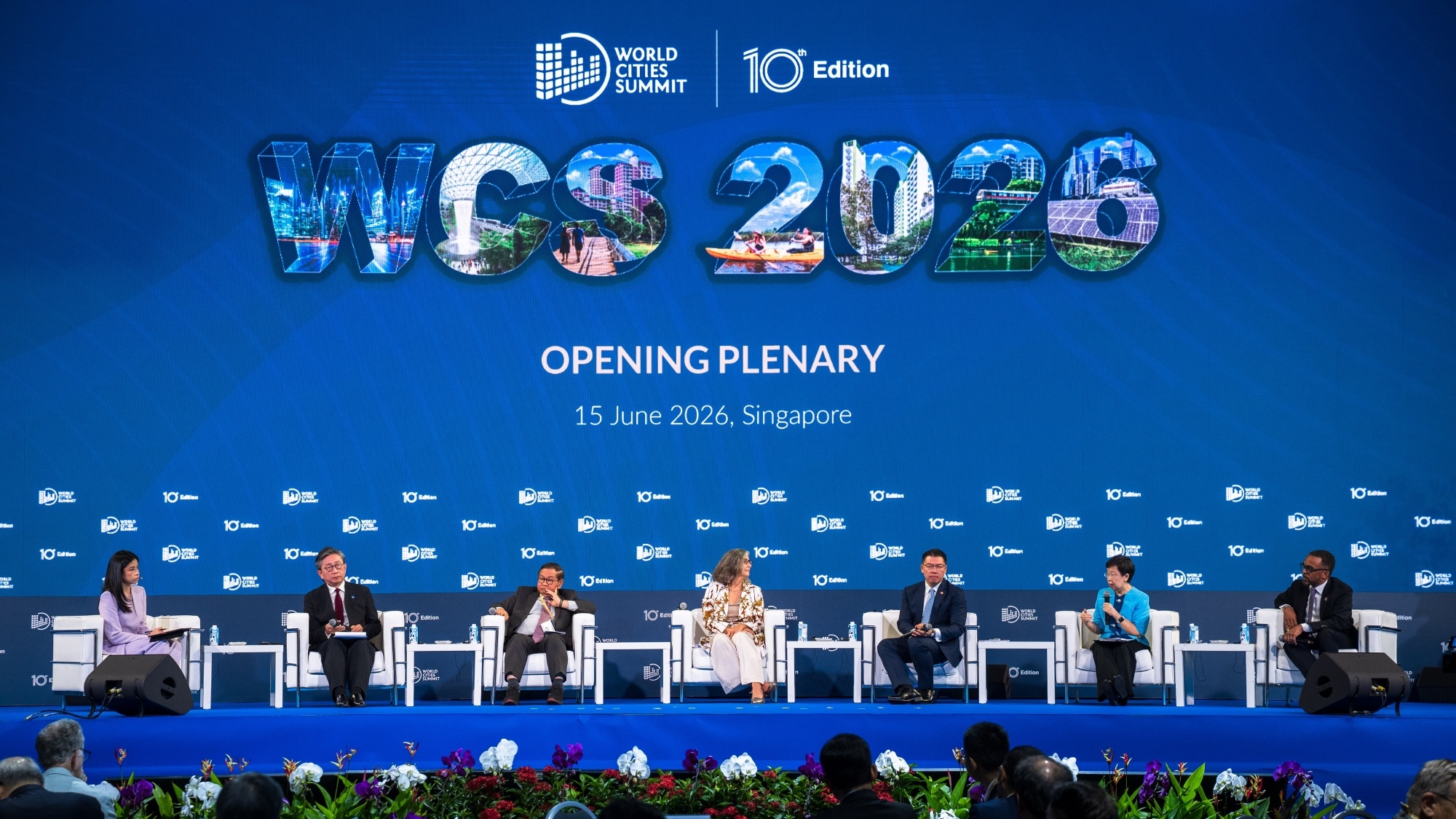
They were led by SMU President Professor Lily Kong who spoke at the Opening Plenary, 15 June, on ’From Aspiration to Acceleration: Implementing National Policies in Urban Contexts’. She also moderated a National Heritage Board panel discussion on ‘Championing Heritage for Loveable Cities’ on the Summit's final day.
Among other speakers and moderators were Associate Professor Theodor Cojoianu, Lee Kong Chian Professor Winston Chow, Professor Orlando Woods, Assistant Professor Aidan Wong, Lee Kong Chian Professor Lim Sun Sun and Ms Nikki Kemp of the Singapore Green Finance Centre, who shared their perspectives on issues ranging from climate resilience and urban transitions to unlocking private capital for cities.
Showcasing research with real-world impact
A highlight for SMU at the Summit was the launch of a new white paper, ‘What is the Value of Urban Resilience?’, authored by Professor Orlando Woods, Director of the SMU Urban Institute. Released on 16 June, the paper calls for a broader and more equitable understanding of urban resilience, arguing that cities must move beyond purely technocratic approaches and place greater emphasis on inclusion, lived experience and community trust.
Drawing on discussions from the fourth edition of SMU City Dialogues, held in Vienna in 2025, the paper identifies four themes: value, governance and partnerships, inclusion, and data and technology.
The paper goes on to offer practical recommendations for policymakers and city leaders seeking to strengthen resilience in an era of compounding global crises. Its launch at WCS 2026 extended these conversations to the international audience of urban policymakers and practitioners present.
At its exhibition booth, themed Bold Ideas, Big Impact – In Action, SMU highlighted research and innovations aligned with both the Summit and the four domains in which the University seeks to make purposeful impact under SMU2030 – human capital development, knowledge creation, economic development and social and community life.
Projects on display addressed three broad lines shaping the future of cities: the future of work and economic opportunity, the future of communities and urban experiences, and the future of resilient urban systems.
Featured research included Singapore's first AI-LLM Exposure Index by Professor Li Jia, which found that higher-skilled white-collar jobs are most exposed to AI disruption; Cooling Singapore 2.0, led by Professor Winston Chow, which developed tools to better understand heat risks across the city; and Professor Paulin Straughan's work on ageing, which showed that community continuity and place identity are key predictors of wellbeing among older adults.
Other research explored housing affordability through an integrated framework lens, data centre greening via a value-chain strategy, the role of augmented reality in shaping interactions with public spaces, as well as the coexistence of humans and wildlife in urban environments. The full showcase of research projects can be found here - https://cityperspectives.smu.edu.sg/wcs-2026/pages/index.html.From ideas to solutions
SMU also showcased innovations supported by its Institute of Innovation and Entrepreneurship (IIE), illustrating how research and entrepreneurship can translate into practical solutions for urban challenges.
Among the featured ventures were Magorium, founded by SMU alumna Oh Shu Xian, which converts plastic waste into low-carbon road materials; and Ecoflow, co-founded by three SMU alumni; whose technologies have helped reduce water and energy consumption across more than 200 properties in four countries.
The University also highlighted Qarbotech, one of the high-potential startups being incubated by SMU’s accelerator, Urban SustaInnovator, which was launched last year, and a vehicle-to-grid business model developed by Associate Professor Yangfang (Helen) Zhou, which is being commercialised with support from IIE's Knowledge Transfer and Commercialisation unit.
Engaging diverse perspectives on the future of cities
Throughout the Summit, delegates engaged with SMU researchers, entrepreneurs and students through a series of talks and interactive experiences.
At the heart of the booth was City Voices, an interactive polling initiative that, over the three days of the Summit, drew delegates from more than 35 cities to share their views on the challenges, technologies and leadership needed to shape future cities. Visitors also weighed in on a question central to urban development: whether smart innovation or broader inclusion will make the bigger difference in the years ahead.
Through its participation at World Cities Summit 2026, SMU reaffirmed its commitment to generating impact through research, education and innovation, while contributing ideas and solutions to conversations shaping the future of cities.